
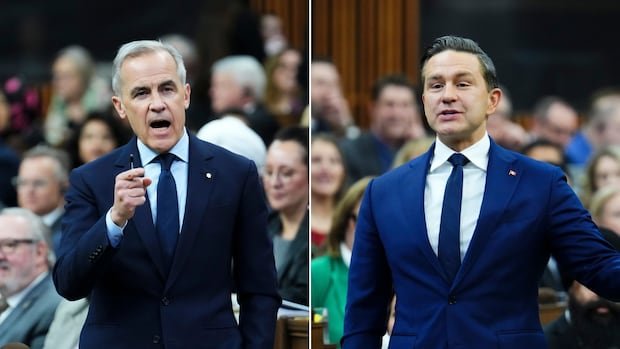

In a lively exchange during question period, Prime Minister Mark Carney and Conservative Leader Pierre Poilievre delved into economic matters on Wednesday, reminiscent of a university seminar. This clash marked their first encounter in the House following the Liberal government’s majority win.
The discussion arose after Poilievre criticized Carney’s economic acumen in an interview with the Canadian Taxpayers Federation. The focal point of the debate revolved around gas taxes, with Carney teasing Poilievre over his remarks on the Prime Minister’s economic education while Poilievre questioned Carney’s familiarity with his own budget.
Poilievre began by condemning the Liberals’ decision to temporarily halt the excise tax on gasoline and diesel, advocating for a complete removal of the GST on fuel as well. Carney rebuffed this proposal, cautioning that such actions would significantly escalate the deficit, a stance Poilievre typically opposes.
The Conservative leader criticized the Liberals for inflating the federal deficit, citing figures from the recent budget projections. Poilievre accused Carney of contributing to inflation, to which Carney, a PhD holder in economics, defended his background, subtly alluding to Poilievre’s earlier comments.
Carney emphasized the importance of historical analysis and numerical scrutiny in economics education, highlighting his successful tenure as the governor of the Bank of Canada and Bank of England. Poilievre, continuing the education analogy, suggested Carney may have misunderstood critical lessons.
The Prime Minister quipped that Poilievre’s responses would not pass an exam, insinuating a lack of understanding. Carney slyly referenced Poilievre losing MPs to the Liberal camp in recent months, suggesting a need for attentive listening.
The temporary suspension of the excise tax was announced by Carney, leading to a 10-cent reduction in gasoline prices and a 4-cent drop in diesel costs until Labour Day. Poilievre had earlier proposed extending the tax pause until the year-end. This move comes amid soaring gas prices fueled by the Middle East conflict, pushing the national average to $1.83 per liter as of Wednesday, a sharp increase since the disruption in oil flow through the Strait of Hormuz.
Carney’s majority victory was facilitated by five opposition MPs, predominantly former Conservatives, who joined the Liberal ranks.
The contentious debate highlighted contrasting economic perspectives between the two leaders, underscoring the challenges in addressing fuel taxes amidst global uncertainties.