

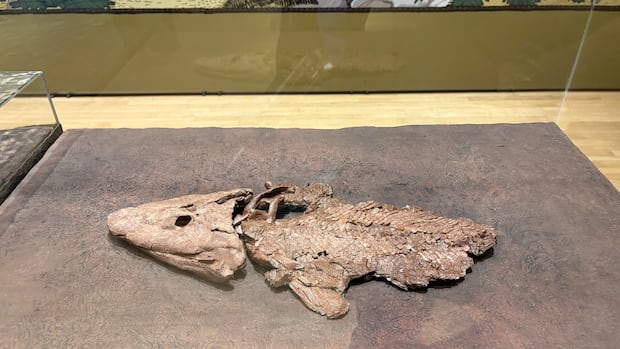

A recent study featuring a fossil dated at 380 million years from Nunavut has ignited fresh inquiries among scientists regarding the initial reasons tetrapods evolved necks.
Discovered on Ellesmere Island twenty years ago, Tiktaalik roseae has been identified by researchers as the earliest known tetrapod, or four-limbed creature, featuring a distinct separation between its skull and shoulders. Experts have long theorized that this species developed a neck to enhance head movement as it transitioned to terrestrial life.
Dana Korneisel, a postdoctoral researcher at Carleton University, serves as the lead author of the new research released this month in the journal Nature. The study was conducted by a team from Carleton and the University of Ottawa, which performed experiments on lake sturgeon, the closest modern anatomical relative to Tiktaalik roseae.
The research also included contributions from scientists at Penn State University and the University of Washington in the United States.
After completing the tests, the researchers estimated that Tiktaalik roseae could likely bend its neck by less than six degrees side-to-side.
“The prevailing notion was that the emergence of the anatomical neck would facilitate the ability to bend and twist the neck, allowing for head movement in relation to the body,” Korneisel remarked.
“Our findings showed very restricted mobility for bending, both sideways and up and down, similar to what is observed in contemporary fish.”
Hillary Maddin, a paleontologist at Carleton University and co-author of the research, noted that the outcomes prompt new inquiries and hypotheses regarding the evolution of necks.
“It may have been more about achieving a more independent and robust stabilization of the limbs and shoulder girdle on the substrate as it began to move on land,” Maddin suggested.
The necessity for limb movement
Based on the findings from the experiments with modern lake sturgeon, researchers now propose that Tiktaalik roseae developed its neck to gain improved control over its front limbs. Korneisel points out that prior research on the bending or twisting capabilities of early tetrapods was minimal.
She adds that the study was significantly aided by a previous three-dimensional reconstruction of Tiktaalik roseae’s neck region created by co-author Tom Stewart at Penn State University.
In addition to Tiktaalik roseae, the team analyzed fossils of other ancient tetrapods to ascertain neck dimensions, which were then applied to a modern sturgeon’s spine using a universal testing machine at the University of Ottawa.
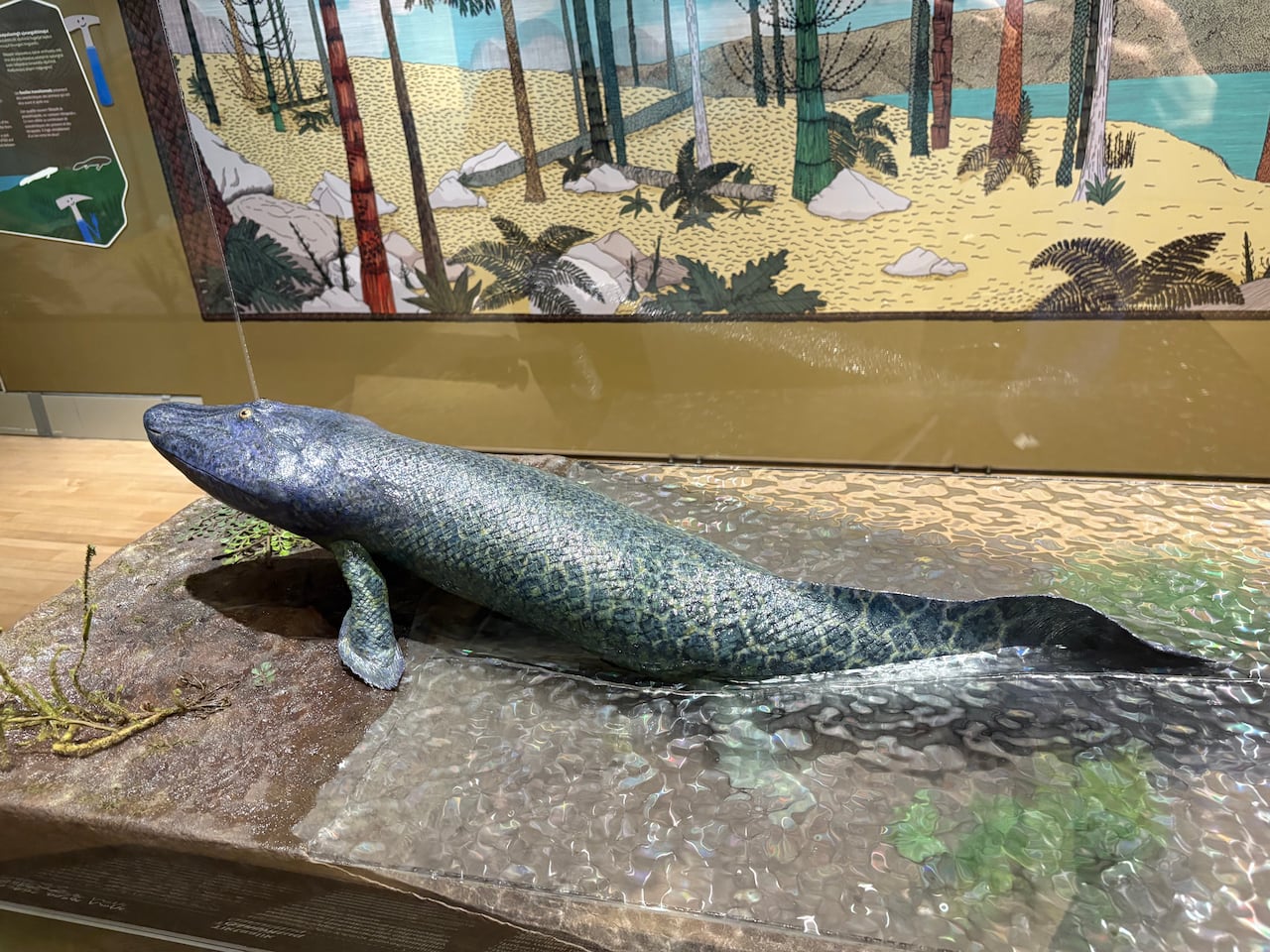
A modern recreation of Tiktaalik roseae at the Canadian Museum of Nature in Ottawa. The prehistoric tetrapod is believed to be the first species to have developed a neck. (Liam Baker/CBC)
“There’s some evolutionary factor that is leading to this separation of the shoulder girdle and the skull… if the advantage isn’t enabling more head movement, then what could be the evolutionary rationale behind this?” Korneisel questioned.
“What aligns with other data from various researchers is that the pectoral girdle and forelimb were being used for new types of motion and locomotion.”
The researchers concluded in the new study that early tetrapods likely had limited neck mobility that was better suited for more effective swimming patterns and for supporting the shoulders during the movement of their forelimbs.
Connections to human evolution
While the study presents a potential alternative explanation for the origins of necks in tetrapods, Korneisel expresses her hope to perform tests on other well-preserved early fish soon. She believes this type of research could yield deeper insights into how Tiktaalik roseae and other primitive tetrapods moved throughout their bodies.
Maddin asserts that the findings also provide valuable perspective on human evolution.
-
Nunavut’s ancient Qikiqtania fish fossil helps shed new light on evolution
-
Video
Arctic fossil unveiled at nature museum
“Considering the state of life on Earth during this period, vertebrates were very scarce, including the group of animals we belong to. Thus, this is a crucial milestone in the evolution of our lineage and all terrestrial vertebrates,” Maddin concluded.