

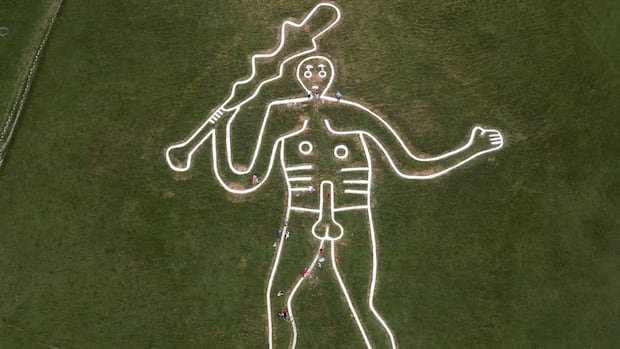

The residents of Cerne Abbas have a strong affinity for the iconic naked, club-wielding giant etched into the Dorset hillside overlooking their British village. Due to a succession of mild, damp winters, the 55-meter chalk figure has become overgrown with grass and algae, obscuring its distinct white lines.
Over 100 volunteers from the National Trust in the U.K. have been diligently working on the steep hill, enduring sweltering temperatures, to restore the Cerne Abbas Giant to its former splendor. Liz Flight, the National Trust’s senior visitor experience officer, described the painstaking labor involved in the restoration process, emphasizing the community’s deep affection for the figure.
The origin of the giant, known as “The Old Man” or “The Rude Man,” is shrouded in mystery. While it was once thought to have Roman roots, a 2001 National Trust analysis revealed its creation in the late Saxon period, spanning from 700 to 1100 AD. The exact identity and purpose of the figure remain uncertain, with speculations linking it to the mythological figure Hercules due to its masculine portrayal.
Maintaining the Cerne Giant is a significant undertaking for the National Trust, with touch-ups typically conducted every decade to preserve the figure. Flight emphasized the delicate balance between conservation efforts and protecting the underlying archaeology, as frequent re-chalking can harm both the landscape and historical artifacts.
The ongoing restoration marks the fourth re-chalking of the giant, ahead of schedule due to recent weather conditions. Warmer winters have facilitated the rapid growth of grass and algae, necessitating the removal of vegetation and the application of fresh chalk. Despite challenges such as scorching heat affecting work hours, volunteers remain dedicated to the project, striving to ensure the Cerne Abbas Giant maintains its prominent presence on the hillside.