

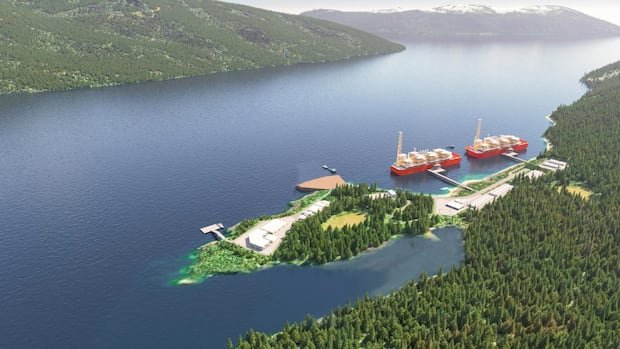

A recent announcement revealed that the Ksi Lisims LNG project has secured a deal to sell liquefied natural gas to a German utility, potentially increasing British Columbia’s annual greenhouse gas emissions by six to eight percent. This calculation was based on estimates provided by a report from Environment and Climate Change Canada in 2024, outlining emissions from gas extraction, transportation, facility construction, and operation.
The agreement entails the German utility purchasing one million tonnes of LNG annually from the project, which is projected to have a total capacity of 12 million tonnes per year. The report presented two scenarios: one with the facility connected to the B.C. Hydro grid, resulting in lower emissions, and another scenario where the facility is powered by gas-generated electricity, leading to higher emissions.
Emissions associated with the construction and operation of the facility vary between the scenarios, with the report indicating potential annual emissions ranging from 58,877 to 212,109 tonnes of carbon dioxide equivalent. The project, co-owned by Western LNG, Rockies LNG Partners, and the Nisga’a Nation, aims to achieve net-zero emissions once connected to the grid, utilizing carbon offsets as part of the strategy.
While the environmental assessment considered emissions from the facility’s construction and operation, it did not include emissions from gas extraction and transportation, which constitute a significant portion of the total emissions. The project proponents argue that despite potentially increasing provincial and national emissions, the project could be beneficial on a global scale by replacing dirtier energy sources with lower-emission LNG.
It remains uncertain whether the Ksi Lisims project would have a positive impact on global emissions, with various factors influencing its overall environmental impact. The deal with Germany’s Securing Energy For Europe (SEFE) involves the purchase of LNG for up to 20 years, highlighting the potential capacity and scope of the project, pending a final investment decision.