


In June 2024, an individual from Ontario who was visiting Montreal parked his Honda Accord on a city street in a busy area. The following day, it was missing.
The man, who chose to remain anonymous due to concerns about potential retaliation from a criminal group, reported the incident to the police and received compensation from his insurance, but he never heard any updates regarding his vehicle.
After three weeks, law enforcement officers monitoring a warehouse in Montreal’s Saint-Laurent district noticed his car being loaded into a shipping container.
The officers observed a group of men putting the Accord deep within the container, followed by two older vehicles and stacks of mattresses.
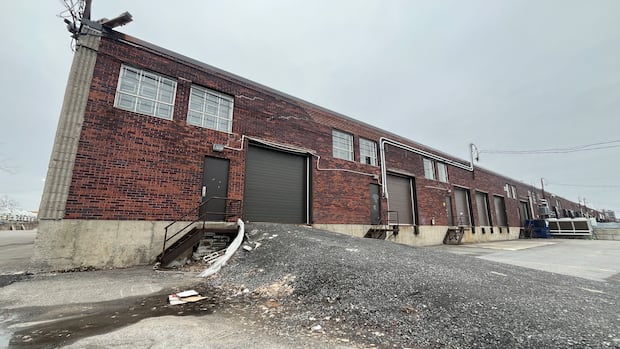
The warehouse at 407 Lebeau Blvd. was operated by Albert Logistique, a Quebec-registered business that claimed to export mattresses to Africa.
However, an investigation revealed that this warehouse was not solely used for mattress exports. It served as the central hub for a trans-Atlantic network involved in the exportation of stolen vehicles, according to police documents reviewed by CBC.
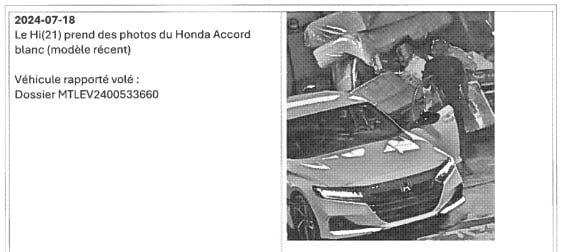
Surveillance images capture workers loading a stolen vehicle and mattresses into a shipping container at the 407 Lebeau Blvd. warehouse in Montreal. (Sûreté du Québec report)
According to the documents, Albert Tshiyoyo was identified as the individual behind Albert Logistique, linked to the car export network.
An investigation by CBC into the car export sector in Montreal discovered that Tshiyoyo continues to operate as an exporter, now shipping mattresses and vehicles from a different warehouse in Saint-Laurent.
Documents and inspection reports reveal that he is among numerous exporters in Montreal associated with the transport of stolen vehicles overseas. No charges have been brought against Tshiyoyo.
Industry sources have indicated that organized crime is widespread within Montreal’s export sector, with many exporters involved in the shipment of stolen cars.
According to police intelligence reports, these exporters have significantly contributed to a recent increase in auto thefts across eastern Canada, creating a market for stolen vehicles and, in some instances, directly participating in the thefts.
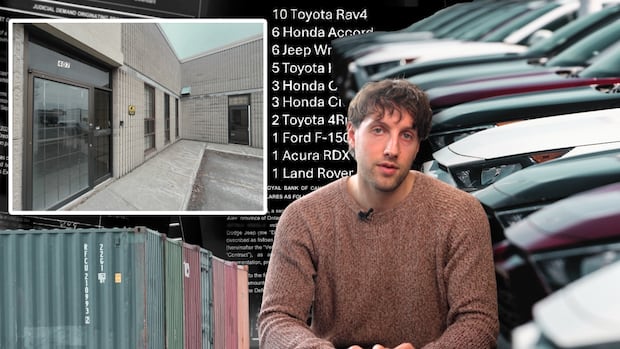
Montreal’s export sector is rife with businesses involved in the shipment of stolen vehicles. They operate from various warehouses throughout the city. We tracked some of them down.
CBC discovers multiple exporters associated with stolen vehicles
Montreal’s industrial parks are home to numerous export businesses.
Thanks to its port, the city serves as a key departure point for goods being sent to international markets, including grain, petroleum products, wood, and containers.
A large portion of container shipping is overseen by freight forwarders, who manage logistics for exporters aiming to send products overseas.
However, freight forwarders — who requested anonymity for fear of repercussions from possible criminal activities — reported that many of the exporters they work with have connections to auto theft.
The prevalence of these exporters is so significant that many freight forwarders maintain extensive lists of companies they refuse to engage with.
While many of these companies are legally registered, they sometimes pose as legitimate import/export brokers, while at other times they claim to be involved in used car sales or clothing transport.
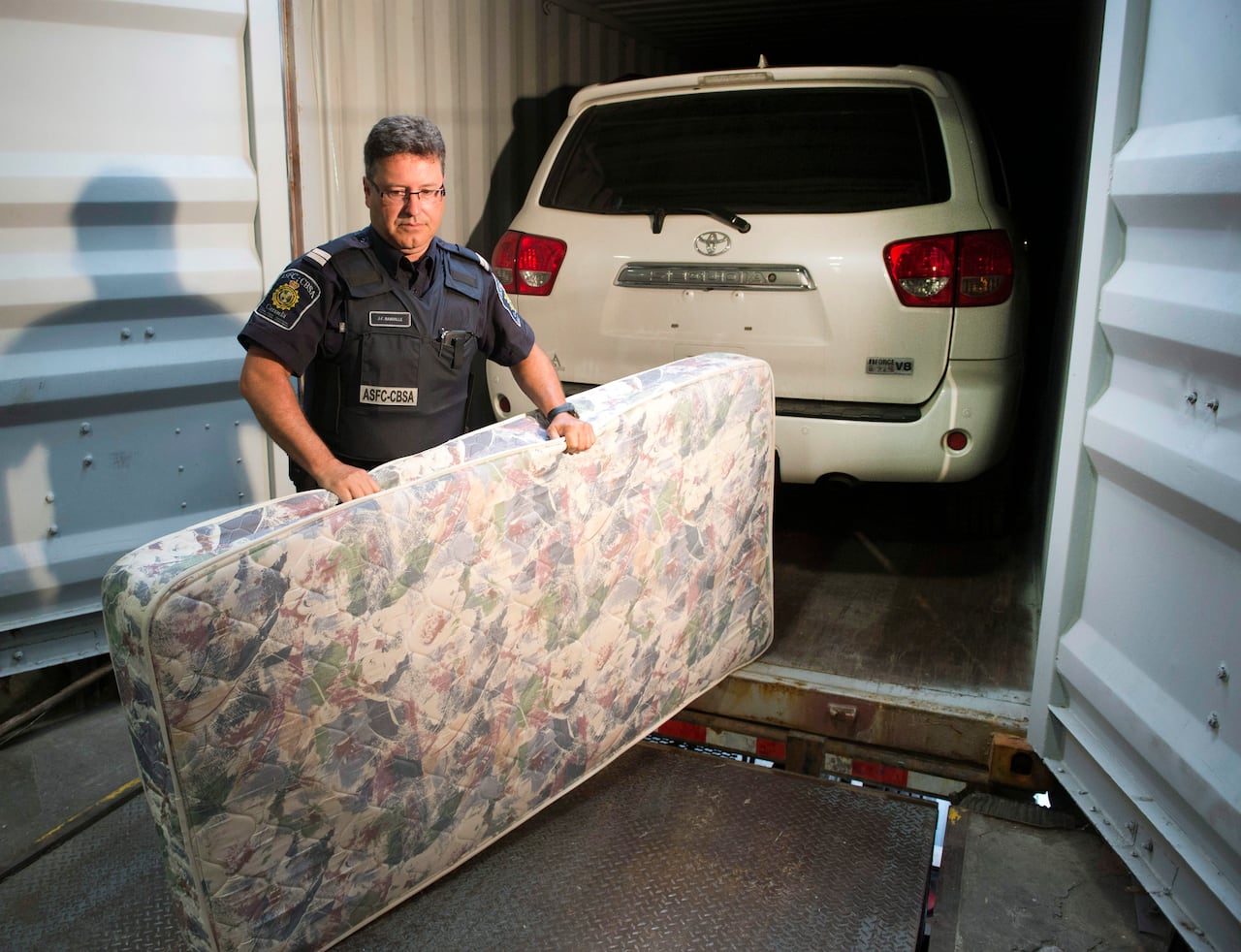
CBSA Supt. Jean-François Rainville retrieves a mattress used to conceal a stolen Toyota Sequoia in a container during a news conference on July 17, 2014, in Montreal. (Ryan Remiorz/The Canadian Press)
One freight forwarder provided CBC with inspection documents that identified numerous exporters in the Montreal area whose shipments included stolen vehicles.
Many of these companies continue to operate and are engaged in sending products abroad.
One unnamed company, which could compromise the identity of the freight forwarder, attempted to export a batch of vehicles in 2025. That shipment was intercepted at the Port of Montreal and revealed to contain stolen cars.
In a conversation with CBC, an owner from this company denied any involvement in shipping stolen cars — or any vehicles in recent years — but admitted that his company had unknowingly shipped stolen cars in the past, insisting it was an accident.
Another company owner, whose shipments have also been confiscated due to containing stolen cars, denied any connections to vehicle theft and declined to answer further inquiries.
Still operational
As of March 2026, Tshiyoyo, the exporter identified by law enforcement as having links to stolen vehicles, has not faced any criminal charges, despite police raiding his warehouse in 2024 and discovering stolen cars intended for export alongside mattresses.
Information about Tshiyoyo remains limited. He is mentioned in police records as “Albert,” a Congolese national who ran the mattress warehouse at 407 Lebeau Blvd. in 2024, hiring workers to load stolen vehicles into containers.
Using two businesses, Transit Express Global Services and Albert Logistique, records indicate he exported vehicles internationally. Police investigations have confirmed that 38 stolen vehicles passed through the warehouse where Tshiyoyo’s companies were located.
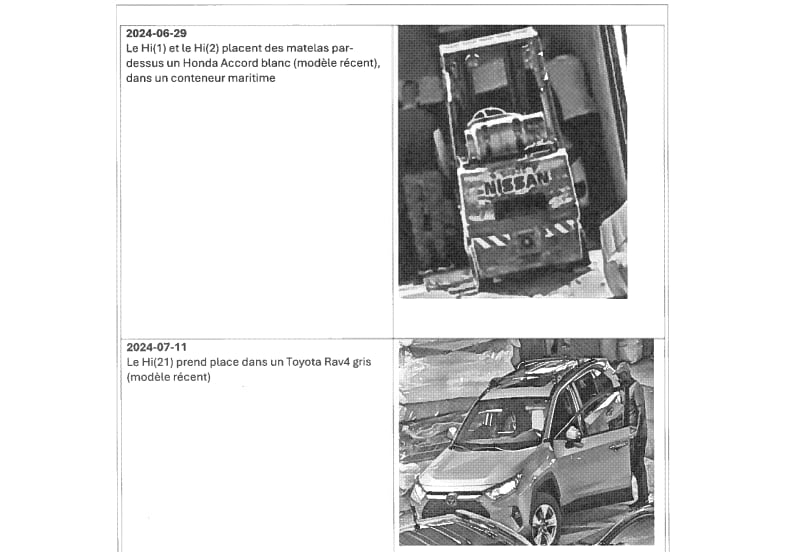
Law enforcement officials captured these surveillance images of individuals loading cars and mattresses into shipping containers at the warehouse located at 407 Lebeau Blvd. (Sûreté du Québec report)
CBC News has confirmed that Tshiyoyo is still conducting business since the police raid.
He is currently operating a mattress business named C&N Matelas express inc. (C&N mattresses). Although business records list the company’s address as a U-Haul storage facility, multiple sources have verified to CBC that it is actively functioning within a warehouse at a different site in Saint-Laurent.
C&N Matelas express inc. claims its activities involve mattress sales; however, during a recent visit to the warehouse, a CBC reporter witnessed cars and mattresses being loaded into a shipping container.
On a subsequent visit, a woman identifying herself as Mary stated she would relay CBC’s inquiries and requests for interviews to “Albert.”
She confirmed that the company does ship vehicles but denied any knowledge of shipments involving stolen cars, asserting that the company verifies the legality of its exported vehicles.
Tshiyoyo has not responded to multiple requests for comments.
‘It’s likely happening to someone else’
Lucas Bastien, a representative for Quebec’s public prosecution service, the DPCP, stated that there is “no public information” available regarding Tshiyoyo or Project Submersible, the police investigation focused on Tshiyoyo’s operations and warehouse in 2024.
Bastien advised CBC to follow up in the coming months.
The inquiry into the car theft and export network allegedly linked to Tshiyoyo is still active, as stated by Gregory Gomez Del Prado, a spokesperson for the Sûreté du Québec (SQ), Quebec’s provincial police.
Project Submersible is part of several investigations that the SQ and its partners are currently undertaking to address car theft, according to Gomez Del Prado.
While he could not provide details about an ongoing investigation, Del Prado mentioned that delays are typical in intricate cases targeting potential criminal organizations. Police conduct raids early in investigations to gather sufficient evidence before making arrests and filing charges, minimizing the chances of a case being dismissed due to judicial delays.
One shipment observed by CBC being loaded at the C&N Matelas express inc. warehouse in late February was placed onto a cargo vessel at the Montreal port and sent to Matadi, Democratic Republic of Congo. It departed on February 27 and was still en route at the time of this report.
The Ontario man whose vehicle was stolen in 2024 expressed his disbelief upon discovering that the individual linked by police to his stolen car still seems to be running a mattress business and exporting vehicles.
“This happened to me, but as we speak, it’s probably happening to someone else as well,” he remarked.