

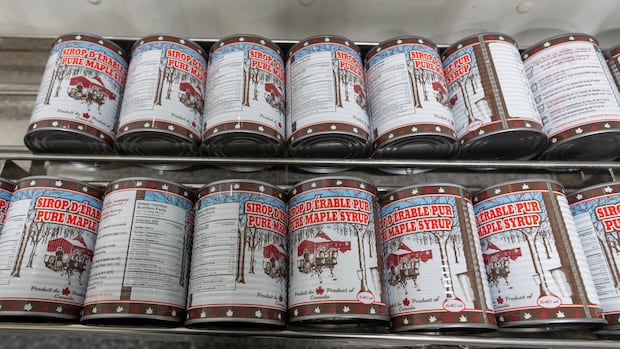

According to the head of Quebec’s maple syrup producers’ organization, the province’s strategic reserve of syrup has been depleted due to a surge in demand.
Luc Goulet, president of Québec Maple Syrup Producers, emphasizes that governmental assistance is essential to capitalize on opportunities for growth within the industry.
The yield of maple syrup is influenced by climatic conditions. Consequently, the producers’ association established a strategic reserve to maintain stable prices and supply.
Last year, commercial buyers in the U.S. increased their stock levels, anticipating potential tariffs from U.S. President Donald Trump.
Goulet reports that the reserve has been fully depleted as sales continue to escalate.
“Our strategic reserve has been brought down to zero,” Goulet stated during an interview coinciding with the release of a report detailing the industry’s economic impact.
This situation could lead to a loss of customers if sap flow is adversely affected by weather conditions, he warned.
Goulet points to the stock shortages experienced in 2007 and 2008 as a cautionary example.
“We lost certain markets because the product wasn’t accessible,” Goulet explained. “Consumers quickly turned to alternative sweeteners. Once that shift happens, those new consumption patterns tend to stick.”
According to the president of the Maple Industry Council, which represents licensed buyers, Quebec’s maple syrup is increasing its market presence internationally.
Louis Turenne reports that exports rose by 9.34 percent in 2024 compared to the previous year, with growth accelerating to 15.8 percent in 2025 amid concerns about new tariffs affecting the sector.
In 2026, exports grew at a slower pace, increasing by 2.48 percent from January to August compared to the same period the previous year.
“It’s always challenging to surpass an exceptional year,” Turenne remarked.
Currently, nearly 65 percent of maple syrup exports are directed to the United States. (Christinne Muschi/The Canadian Press)
Goulet recognizes that meeting the needs of enthusiastic consumers is a favorable challenge.
Nevertheless, he believes there is still significant growth potential for the industry. “There is a vast amount of unexplored potential in Quebec’s maple groves,” he mentioned.
Goulet expressed concern that investments from Quebec City “are not sufficient for our needs,” and he hopes to engage with the newly elected Parti Québécois government.
“When we’re told that our industry is flourishing and that we don’t require support — I no longer accept that perspective from the government,” he stated.
Turenne believes Quebec could boost production by offering financial aid to producers and assisting processors in their quest for international markets.
At present, approximately 65 percent of maple syrup exports are sent to the United States.
“We have made considerable strides in market diversification over recent years. Two decades ago, that figure was 80 percent,” Turenne noted.
“However, we need to expedite the opening and expansion of markets in Europe, Australia, and Asia to lessen our reliance on the U.S. market,” he added.
Industry centered in Quebec
While the maple leaf is featured on the Canadian flag, the syrup industry is predominantly located in Quebec.
According to the industry group’s report released Thursday, the province accounts for over 70 percent of North American production.
When considering production, processing, and specialized equipment manufacturing, the maple syrup sector contributed $1.21 billion to the gross domestic product in 2025, as reported.
Overall, the industry employs upwards of 10,000 full-time equivalent workers and generated $285 million in tax revenue, not including municipal taxes and public land lease fees.
This figure excludes the sugar shacks that many residents of Quebec frequent during the spring season.
“Operations at sugar shacks are more comparable to the restaurant business,” Turenne remarked.
The maple syrup producers’ association leveraged the recent election campaign to underscore the industry’s significance as a key employer and economic contributor, with Goulet noting that candidates were often surprised by its substantial role.
In some towns, “if you eliminate maple syrup production, you might as well close down the villages,” Goulet stated.