

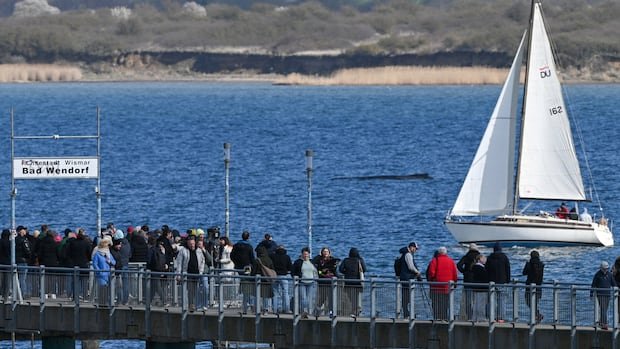

A juvenile humpback whale named Timmy found itself stranded in the shallow waters off the Baltic coast of Germany once more on Sunday morning, raising concerns about its survival after enduring a week-long struggle. Timmy, estimated to be between 12 to 15 meters long, faced challenges due to its large size, prompting rescuers to employ dredging tools and boats to guide the whale back towards the Atlantic Ocean.
Despite ongoing efforts to assist the distressed animal, hopes now rest on Timmy’s ability to navigate its way out independently. Greenpeace marine expert Daniela von Schaper expressed optimism about the whale’s chances of recovery, despite its weakened state. Timmy, whose gender remains unknown, was named after Timmendorfer Strand, a popular beach along Germany’s resort-packed Baltic coast where it was first sighted stranded on a sandbank a week ago.
Repeated rescue endeavors have been thwarted, with Greenpeace and its collaborators observing the whale in severe distress, suffering from skin irritations and entangled fishing gear in its mouth. While there were fleeting moments of progress over the weekend as the whale managed to free itself briefly, it soon encountered further challenges.
Humpback whales are not typical inhabitants of the Baltic Sea, but sporadic sightings of large whales occur every few years in the region, according to von Schaper. Conservationists attribute whale strandings globally to disrupted migration paths and human activities, as well as the animals’ potential confusion while foraging for food.
Von Schaper emphasized that some stranded whales eventually find their way back to open waters, while others are less fortunate. The incident highlights the impact of climate change on marine life, with warming waters off the U.S. West Coast posing risks for humpback whales, potentially leading to more entanglements in fishing gear and endangering their survival.