

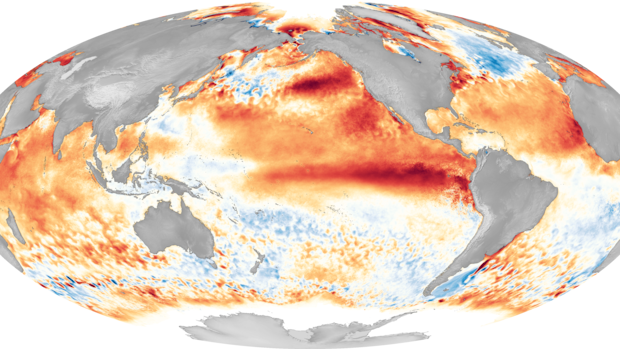

A potential “super” El Niño is being discussed as a possibility in the near future, which could lead to a rise in the global temperature and worsen extreme weather conditions. Various climate models are indicating a strong El Niño expected to start around June or July, peak in November, and potentially result in ocean temperatures in a key Pacific region exceeding the average by 2 degrees Celsius, with some models suggesting even higher anomalies.
El Niño is a component of a broader atmospheric and oceanic system known as the El Niño-Southern Oscillation (ENSO), impacting weather patterns worldwide. When temperatures in the Pacific’s Niño 3.4 region are higher than usual, El Niño occurs, while lower temperatures trigger La Niña, with a neutral phase also observed.
The U.S. National Oceanic and Atmospheric Administration (NOAA) recently issued its monthly ENSO update, indicating an 82% likelihood of El Niño developing between May and July and a 96% chance of continuation from December to February, with uncertainty about its peak strength.
Under normal circumstances, trade winds move warm water from South America towards Asia in the Pacific Ocean. However, during El Niño, these winds weaken, causing a reversal in this process. While a potentially strong or ‘super’ El Niño could be on the horizon, its impact on Canada this summer is anticipated to be minimal.
Nevertheless, the effects of a robust El Niño will be felt globally. The most significant impacts on Canada are typically experienced during the winter when warm conditions prevail, particularly in Eastern and Central Canada. The country’s warmest winter on record occurred during the previous strong El Niño, with a temperature anomaly of 1.5 degrees Celsius in the Pacific’s El Niño 3.4 region, expected to be surpassed in the upcoming event.
Climate experts emphasize that the combined influence of El Niño and ongoing climate change is likely to result in unprecedented weather extremes and potentially record-breaking temperatures in the coming years. While El Niño may contribute to extreme conditions, the primary concern remains climate change and the urgent need to reduce fossil fuel consumption to mitigate its impacts.
Moreover, the recent warmest winter experienced by many U.S. states underscores the escalating impact of climate change. The World Weather Attribution concluded that a March heat wave in the U.S. was significantly influenced by climate change. Furthermore, Canada and other regions are facing increased risks of wildfires and extreme weather events due to the compounded effects of El Niño and global warming.