

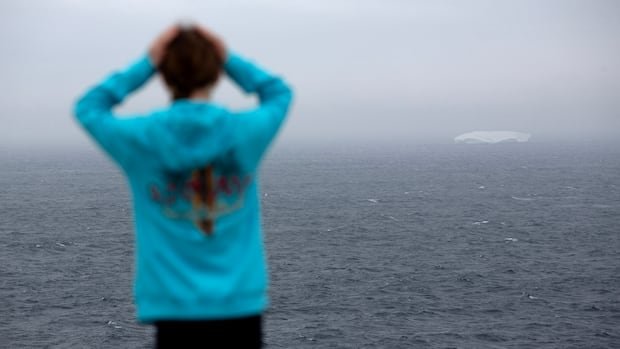

On a sunny afternoon in St. John’s, atop Signal Hill, a continuous flow of individuals strolled along a rocky edge, marveling at the sight before them. Some erupted in cheers, while others hastily reached for their phones to capture the moment – an iceberg peacefully floating in the waters below, having broken off from a glacier in Greenland and carried by the Labrador current to Newfoundland and Labrador.
This year is proving to be exceptional for icebergs in the region, drawing tourists and locals to various shores to witness these ancient visitors. Susan Davis, a visitor from Baltimore, expressed her delight, describing the scene as “joyous” and praising the intense and magnificent colors on display. She noted that despite having seen calving glaciers in Alaska, this experience was entirely new to her.
The annual iceberg spectacle is a distinctive feature of Newfoundland and Labrador, with nearly double the usual number of icebergs this year. Satellite data indicated the presence of approximately 520 icebergs off the east coast of Newfoundland and southern Labrador by Wednesday afternoon, as reported by George Karaganis, a senior meteorologist with the Canadian Ice Service. This figure surpasses last year’s count of about 426 icebergs and exceeds the average count of 274 from 2002 to 2021.
The conditions for a successful iceberg season unfold over several years, commencing in Greenland where ancient glaciers begin calving. These ice fragments embark on a journey spanning three years before arriving in Newfoundland and Labrador, propelled by the Labrador current past Baffin Island and through the Labrador Sea. If spring winds blow strongly from the northeast, the icebergs are pushed closer to the shore, offering a spectacle for onlookers.
While this year’s alignment of conditions has led to an abundance of icebergs, experts caution that their numbers are projected to dwindle due to climate change. The decline in sea ice, which shields icebergs from melting before reaching the region, is anticipated as sea ice concentrations diminish amidst warming waters, as explained by Pradeep Bobby from C-CORE, an engineering and research organization in St. John’s.
In Twillingate, N.L., Pat Bridger woke up to the sight of an iceberg floating outside her sewing room window, a common occurrence during the thriving iceberg tourism season in the self-proclaimed “Iceberg Capital of the World.” Enthusiastic about these natural wonders, Bridger eagerly captures photos, hoping to catch glimpses of shimmering gold and silver under the sunlight.
Alick Tsui, a photographer based in St. John’s, expressed his excitement while observing an eagle’s nest awaiting hatching and two icebergs offshore. Reflecting on a recent tour boat excursion to view the icebergs up close, he marveled at the ever-changing colors and sparkles reflected in the sunlight as the ice interacts with the water.
Even the interior of an iceberg holds fascination, as Davis recounted her experience on a tour boat where the guide distributed ice chunks for inspection. She was surprised by the hardness of the ice and the delicate ice crystals within, a stark contrast to the perception of a standard ice cube. Davis marveled at the age of the ice, estimating it to be 15,000 years old, a realization that left her in awe.
As climate conditions shift, the future of iceberg sightings remains uncertain, emphasizing the fleeting opportunity to witness these majestic natural wonders. Visitors and residents alike continue to be captivated by the beauty and grandeur of these ancient ice giants gracing the shores of Newfoundland and Labrador.