

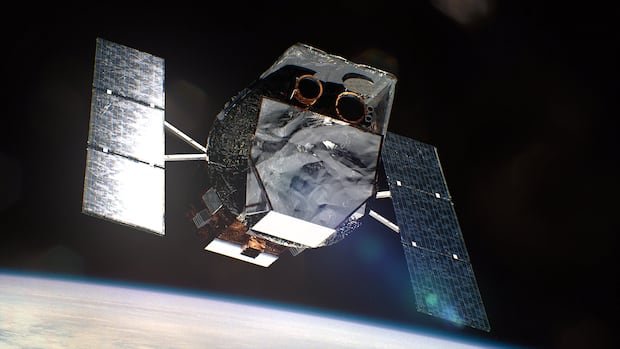

NASA, in collaboration with Katalyst Space, has devised a strategy to prevent the Neil Gehrels Swift Observatory satellite from plummeting to its premature destruction. Originally intended to function until 2030, the observatory is now on a trajectory to disintegrate in the Earth’s atmosphere by year-end due to an unexpected acceleration towards the planet.
To rescue the Swift satellite, NASA and Katalyst Space have partnered to create a robotic spacecraft that will propel Swift back into a higher orbit, potentially extending its operational lifespan by several decades. Brad Cenko, the principal investigator of Swift, mentioned that typically, a project of this magnitude would take decades to develop, but due to the urgent situation, the plan came together in approximately eighteen months.
The initiative involves employing a robotic spacecraft, named LINK, to engage with Swift. LINK, nested within the Pegasus XL rocket attached beneath the modified L-1011 aircraft, Stargazer, will rendezvous with Swift in space. Once connected, LINK’s three robotic arms, resembling lobster claws, will provide the necessary push to reposition Swift.
NASA first detected the Swift’s accelerated descent towards Earth’s orbit in early 2025, a consequence of heightened solar activity which coincidentally enhanced the visibility of phenomena like the Northern Lights. To address this issue, Katalyst was contracted to develop a solution, culminating in the creation of LINK for in-space maintenance, a novel challenge given that Swift was not designed for such procedures.
The mission, scheduled to commence later this month from Kwajalein Atoll, aims to demonstrate the feasibility of in-space servicing. Mason Peck, a mechanical and aerospace engineering professor at Cornell University, views this mission as a significant step towards establishing routine in-space servicing capabilities, potentially leading to future activities such as refueling, component replacement, and infrastructure assembly.
Should the Swift boost mission succeed, it could revolutionize in-space operations, aligning with NASA’s strategic goal to enhance sustainability and cost-effectiveness in Earth orbit activities. Despite the uncertainties, Cenko expressed optimism about the valuable lessons learned from this venture, regardless of the mission’s outcome.