

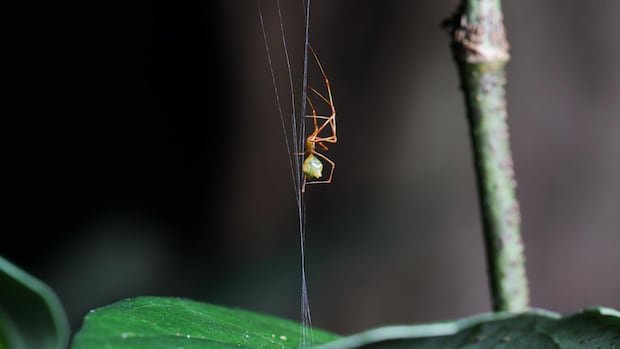

A recent discovery in the tropical rainforests of Australia has amazed scientists with a new hunting method used by a spider species. The spider creates a spring-loaded silk trap that catapults its prey, specifically green tree ants, into its web. This unique behavior led to the nickname “ballista spider,” inspired by ancient Roman weaponry.
Biologist Ajay Narendra from Macquarie University in Australia, who co-led the research, expressed awe at witnessing the spider’s hunting technique. The spider, belonging to the Propostira genus, is yet to be formally named as a species.
The initial observation of this spider was made by researcher Greg Anderson in 2022 in a remote rainforest in Queensland. Subsequently, a team from Macquarie University investigated the spider’s behavior in 2023, using high-speed cameras to document the process. The spiders, measuring three to five millimeters, are nocturnal creatures that construct intricate traps under leaves during the night.
The spiders set their traps by attaching silk tension lines to various anchor points, forming a cone-shaped structure. When green tree ants interact with the trap, they become stuck and are eventually launched into the air, landing in the spider’s main web for capture. The researchers observed that the green tree ants were specifically attracted to the trap, indicating a possible pheromone attraction strategy.
Narendra theorizes that this hunting method evolved as a way to target green tree ants without direct confrontation, considering their formidable nature and group strength. Further research will focus on identifying the specific pheromones involved in this prey specialization.
The launch mechanism employed by the ballista spider subjects the ants to significant G-forces, surpassing those experienced by jet pilots. This hunting tactic differs from that of the slingshot spider, which actively launches itself at prey. The ballista spider’s energy-storing silk trap enables it to launch prey with force while maintaining a safe distance.
The discovery underscores the ongoing mysteries of nature, with much more left to explore and understand.