

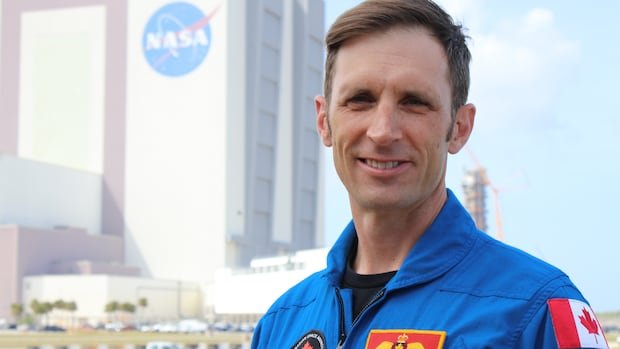

Growing up on a cattle ranch in Fort Saskatchewan, Alberta, Joshua Kutryk always harbored aspirations of venturing into space, although he never envisioned it becoming a reality. However, following Artemis II’s recent circumnavigation of the moon, the 44-year-old is now gearing up for a mission to the International Space Station that holds the promise of significant medical advancements.
Kutryk has been selected as one of the four members of NASA’s SpaceX Crew 13 mission. Alongside NASA astronauts Jessica Watkins and Luke Delaney, as well as Roscosmos cosmonaut Sergey Teteryatnikov, Kutryk will embark on a six-month expedition to the space station for conducting experiments and performing maintenance tasks.
Scheduled to launch from NASA’s Kennedy Space Center in Florida on September 12, the SpaceX Dragon spacecraft will ferry the crew to their destination. Reflecting on his participation, Kutryk expressed pride in being a part of the Canadian contribution to the mission, emphasizing the significance of Canada’s involvement in space exploration.
The mission will incorporate studies led by Canadian researchers to explore the impact of space travel and microgravity on human health. Kutryk highlighted the potential practical applications of these Canadian-sponsored studies not only for future space missions but also for advancing medical treatments on Earth, particularly in areas like heart disease and osteoporosis, where radiation and microgravity affect health.
Emphasizing the unique opportunity to conduct medical research in space due to accelerated aging in microgravity, Kutryk underscored the relevance of these studies to understanding and addressing health challenges faced by humans on Earth. Mathieu Caron, the director of the astronauts’ office at the Canadian Space Agency, noted Canada’s growing expertise in space life sciences as a significant niche.
During the mission, the crew will also be involved in maintenance activities on the space station, including the operation of the Canadian-made robotic servicing system, Canadarm2. Kutryk’s expertise in robotics is expected to be instrumental in these tasks, as he becomes the fourth Canadian to partake in a long-duration mission to the International Space Station.
As NASA plans to decommission the station by 2030, observers anticipate that Kutryk might be the last Canadian to reside on the station. Despite this, Kutryk remains hopeful that his mission, along with recent and upcoming space endeavors, will inspire young Canadians to pursue careers in technical fields and contribute to the future of space exploration.
With the launch date fast approaching, Kutryk and his crew have dedicated years to physical and mental preparation for the mission and are eager to commence their journey into space.