


It is arguably hard to imagine a more disappointing entry point into the The Hunger Games series than the latest prequel, Sunrise on the Reaping.
On the surface, this statement seems absurd. With five films already released in the young-adult, Battle Royale-inspired franchise — four of which center around the tenacious Katniss Everdeen as she strives to dismantle the oppressive Capitol regime that forces randomly chosen children into brutal combat — one might assume that the audience is quite familiar with the narrative.
So, as Sunrise on the Reaping backtracks to recount how one seasoned character faced his own violent competition, why is it that The Hunger Games feels the need to guide viewers through this journey?
The answer lies in the creator’s intentions. Director Francis Lawrence has stated that the aim is to make Reaping accessible for both newcomers and longtime fans, regardless of their familiarity with the previous films — a promise to deliver a compelling and entertaining action film featuring fresh faces while also ensuring it can stand independently.
This is an ambitious dual objective — the first of which Reaping approximately achieves as a relatively solid addition to the crowded and often cliché-ridden young adult post-apocalyptic genre.
However, in addressing the second goal, it either falls short or barely manages to present one of the most oddly grim entries in the “chosen one” narrative genre.
Rather than introducing the indomitable and constantly challenged heroine Katniss, the focus shifts to the battle-weary supporting character Haymitch Abernathy — whose role has primarily been one of despondency — as we learn what has contributed to his deeply flawed character since his first appearance.
This may intrigue those who have been invested in the series from the start and are eager for more content.
For newcomers, however, lacking insight into the eventual outcomes decades later, Reaping presents a different experience. Its portrayal as a painful, almost universally despairing, and relentlessly bleak backstory for a single character renders it a peculiarly strange film when considered as a standalone piece.
Portrayed in the original Hunger Games by Woody Harrelson as a rugged, traumatized former combatant, Haymitch is now played by Joseph Zada. The timeline is set 24 years prior to the events of the first film, just before the Second Quarter Quell.
This term is a deliberately obscure reference to a crucial Hunger Games event, one that fans are aware concluded with even greater carnage and sorrow than usual — and left an older, angrier Haymitch watching in fury as the corrupt government showcased manipulated and propagandistic footage of it in the first film.
For those unfamiliar, this movie could still result in either a heroic triumph or a self-sacrificial act.
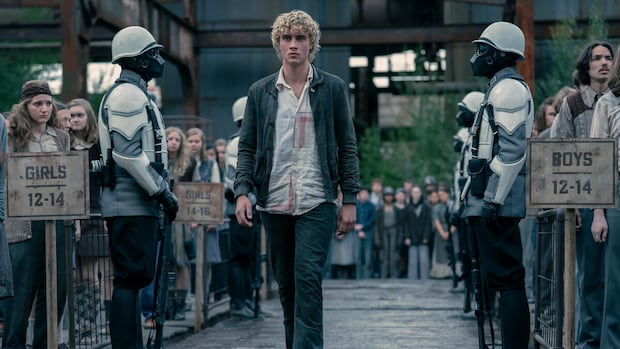
Such expectations seem increasingly likely as we traverse the conventional setup: music video-style scenes of Haymitch assuring his love interest Lenore (Whitney Peak) in a slight Southern drawl that he will never abandon her; Haymitch sacrificing himself to become the “tribute” for his district — the most disadvantaged district in all of Panem; and his sardonic slow-clapping at the indifferent President Snow (Ralph Fiennes) as he observes the suffering and dying young competitors below.

Ralph Fiennes as President Snow in a still from The Hunger Games: Sunrise on the Reaping. (Lionsgate)
These are all expected and effectively executed narrative elements for the tragic or heroic framework to build upon. They gain more narrative weight once the true plot unfolds, as the enigmatic Beetee Latier (Kelvin Harrison Jr.) emerges from the shadows of the arena to present Haymitch with a strategy to undermine the Capitol from within, opting to forfeit winning the competition to prevent the ruling elite from exploiting them.
However, there’s a significant issue: if Haymitch follows through with this plan, he likely won’t survive.
Naturally, since this is the backstory of a character who exists in later Hunger Games films, this outcome seems impossible. Yet instead of ruining the experience for those aware of the broad strokes of the conclusion, it merely diminishes it: what was once intriguingly mysterious trauma in Haymitch’s backstory becomes a drawn-out 30 minutes filled with chaotic, montage-driven alcoholism and more tiny coffins than one would find in a Dracula-themed dollhouse.
While the emotionally heavy representation of trauma in the latter half of Reaping may solidify existing fans’ understanding of Haymitch, it feels utterly bizarre for newcomers. Rather than witnessing a narrative of triumph over tyranny — whether authentic, performative, or pyrrhic — we encounter a cruel twist that lacks a coherent emotional framework or message.
-
REVIEW
Club Kid is one of TIFF’s best. It might make you cry
-
REVIEW
Ebenezer review: Merry Christmas, Johnny Depp! Is this your comeback yet?
A vague theme of learned helplessness is present — the “implicit submission” of the masses obeying a minority as explained by philosopher David Hume, as The Hunger Games author Suzanne Collins has noted. Indeed, the citizens in Reaping fail to recognize their potential power to resist.
Yet aside from a clichéd, hastily tacked-on conclusion — whose emotional impact relies entirely on the assumption that you are aware of Katniss Everdeen’s eventual successes — the remainder feels like mere punishment for the sake of punishment.
The drawn-out, gloomy depiction of Haymitch’s seemingly futile existence serves to elucidate his later rage — a helpful detail if you eventually watch the first film. But apart from the uniqueness of a narrative that denies redemption or fulfillment, there is little else for those venturing into this story.
With the true conclusion of Sunrise on the Reaping being The Hunger Games, it may be wiser to start there. Or perhaps, to not start at all.