

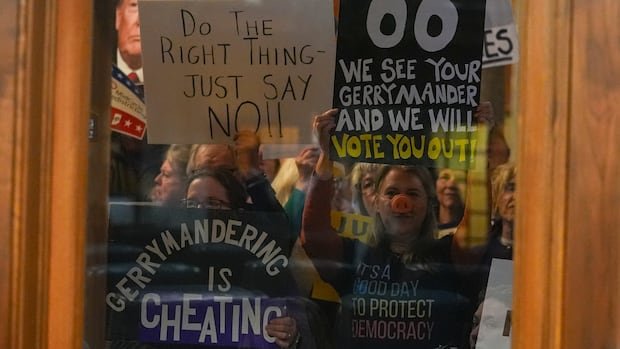

The Republican-controlled Senate in Indiana decisively rejected a revised congressional map on Thursday that would have benefitted the Republican Party, going against pressure from U.S. President Donald Trump and dealing a blow to the White House before the upcoming midterm elections next year.
The vote overwhelmingly opposed the proposed redistricting, with more Republicans against it than in favor, demonstrating the constraints of Trump’s influence in a traditionally conservative state. Cheers and expressions of gratitude were heard inside the chamber when the proposal failed by a vote of 31-19.
State Senator Michael Bohacek, a Republican, criticized the proposal, calling it “bad policy” that overly emphasizes transactional aspects in the legislative process. Bohacek publicly announced his decision to vote against the measure in a previous Facebook post, where he also condemned Trump’s derogatory remarks towards Minnesota Governor Tim Walz, using a slur associated with individuals with intellectual disabilities. Bohacek has a daughter with Down syndrome.
Both Bohacek and Republican Ed Clere, who opposed the bill when it passed through the House last week, faced bomb threats that necessitated police intervention. Clere attributed these threats to Trump’s pressure tactics and a mentality of winner-takes-all.
Apart from safety concerns, there are potential political repercussions. With half of Indiana’s senators up for re-election next year, conservative groups like Turning Point Action, founded by the late Charlie Kirk, have pledged to support campaigns against the Republicans who went against the bill.
Former Governor Mitch Daniels commended the senators for their principled stand in rejecting the new map, labeling it a significant setback for Trump and associated groups.
In a bid to maintain their majority in the House of Representatives, Trump has been urging Republicans across the country to redraw their congressional maps. While some states like Texas, Missouri, Ohio, and North Carolina complied, Indiana’s rejection of the proposal signifies a setback for this strategy.
The proposed map in Indiana aimed to secure Republican control of all nine congressional seats in the state, up from the current seven. It planned to divide Indianapolis among four districts extending into rural areas, thereby altering the safe district of U.S. Representative André Carson in the city and eliminating the northwest Indiana district held by Democratic Representative Frank Mrvan.
In the face of close political contests, Trump’s involvement and pressure campaign to redraw congressional maps have stirred controversy and resistance, with Indiana’s rejection adding to the challenges faced by the administration in this endeavor.