


U.S. President Donald Trump criticized allies on Tuesday for their lack of support in the U.S. war effort against Iran, urging them in a social media outburst to take care of their own oil needs and emphasizing that it is not America’s responsibility to safeguard the Strait of Hormuz.
Trump mentioned that the military could wrap up its offensive within two to three weeks, declaring that the U.S. would not be involved in the future of the closed strait. He asserted that the countries dependent on the waterway would be accountable for keeping it operational.
In a statement from the Oval Office, Trump stated that it was not the U.S.’s role to manage this situation, emphasizing that other nations, such as France, should take charge. The White House announced that Trump would provide a prime-time address the following evening to update the public on the war progress.
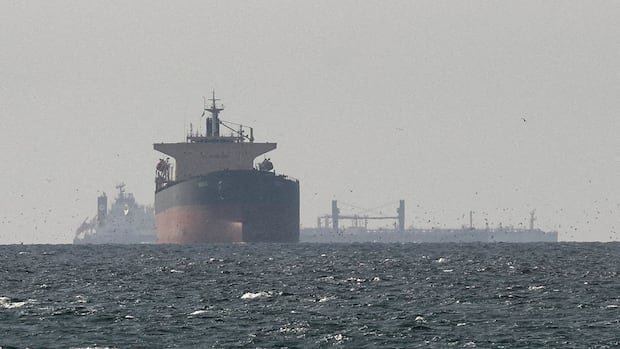
Earlier, the U.S. targeted Isfahan in central Iran, causing a significant explosion, while Tehran attacked a loaded Kuwaiti oil tanker in the Persian Gulf. These strikes demonstrated the ongoing intensity of the conflict after the initial strikes by the U.S. and Israel over a month ago. Prime Minister Benjamin Netanyahu suggested that Israel has achieved over half of its military objectives.
Trump, despite insisting on progress in diplomatic talks for a ceasefire, shared a video of the Isfahan attack, showcasing fiery explosions in the night sky. Isfahan was previously targeted by the U.S. military last year, with satellite images indicating explosions on the city’s southern outskirts.
Following the U.S. and Israel’s attacks, Iran has tightened its grip on the vital Strait of Hormuz, impacting global oil prices. The U.S. gas prices surpassed $4 a gallon on Tuesday for the first time since 2022 due to the strait’s closure.
Defense Secretary Pete Hegseth highlighted the international nature of the strait, mentioning Trump’s remarks that it is a shared responsibility. The UN Security Council planned an emergency session after three peacekeepers were killed in southern Lebanon during Israel’s incursion against Hezbollah.
Trump’s claims of negotiating with Iranian officials were refuted by Mohammad Bagher Qalibaf, Iran’s parliamentary speaker. The arrival of thousands of soldiers from the U.S. Army’s elite 82nd Airborne Division in the Middle East signaled potential reinforcements for Trump’s strategy, including the option of a ground assault.
Netanyahu indicated that Israel is progressing towards its military goals, suggesting unspecified military solutions to counter Iran’s control of the Strait of Hormuz. He criticized European leaders for perceived inaction in supporting the U.S. and Israel.
A Kuwaiti oil tanker was targeted by an Iranian drone in Dubai waters, prompting concerns from Gulf Arab states and escalating tensions in the region. Despite claims from Iran that its operations target U.S. forces, civilian casualties continue to rise, with incidents reported in Dubai, Saudi Arabia, and Bahrain.
The situation remains volatile, with ongoing military operations and diplomatic efforts shaping the complex dynamics in the region.