

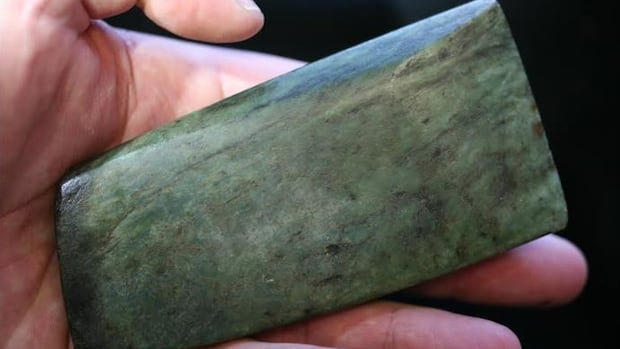

New findings from recent research on jade artifacts discovered to the east of the Rocky Mountains reveal insights into extensive Indigenous trade networks that spanned pre-colonial Western Canada. Over a span of 3,000 years, nephrite jade pieces were meticulously crafted into blades, chisels, and axe heads. These tools, crucial for central and coastal Salish communities in the Pacific Northwest, were made from a durable stone available in various colors like emerald green, black, yellow, and white. Interestingly, some of these stone tools originated in British Columbia and made their way to Alberta, Saskatchewan, and Manitoba after crossing the Rocky Mountains.
A peer-reviewed study conducted by the Edmonton-based Archaeological Survey of Alberta, in collaboration with researchers from the University of Alberta, University of British Columbia, University of Saskatchewan, and Royal Saskatchewan Museum, delved into the significance of these stone celts. These tools, believed to be prestige items, were sourced from British Columbia and traded to Dene and Cree communities east of the Rockies through intricate pre-contact trade networks that transcended cultural and linguistic boundaries.
The research shed light on the mystery surrounding the presence of nephrite artifacts east of the Rockies, where local crafting or deposits of nephrite were absent. By analyzing 24 nephrite celts using advanced techniques such as portable X-ray fluorescence and gamma spectrometry, researchers confirmed their origin in the Fraser River region of B.C. The study proposed various routes through which these artifacts might have traversed the continent, suggesting interactions between Interior Salish craftspeople, Dene groups, and ancestral Cree communities.
Crafting a nephrite celt was a labor-intensive process, with smaller pieces taking over 100 hours to create and larger ones up to 500 hours. As these celts traveled away from their origin, they transitioned from functional tools to prestigious items, akin to sentimental objects displayed for their symbolic value. The research challenges the perception of pre-contact Indigenous groups as isolated, highlighting the importance of relationships and long-distance trade in their societies.
Kisha Supernant, director of the Institute of Prairie and Indigenous Archaeology at the University of Alberta, commended the study for showcasing human connections and dispelling the notion of isolation among pre-contact Indigenous groups. The researchers’ engagement with Indigenous communities and incorporation of traditional oral histories further enriches the study’s understanding of pre-contact Indigenous cultures. Going forward, the research team plans to deepen their collaboration with Indigenous communities to enhance the interpretation of their findings.