

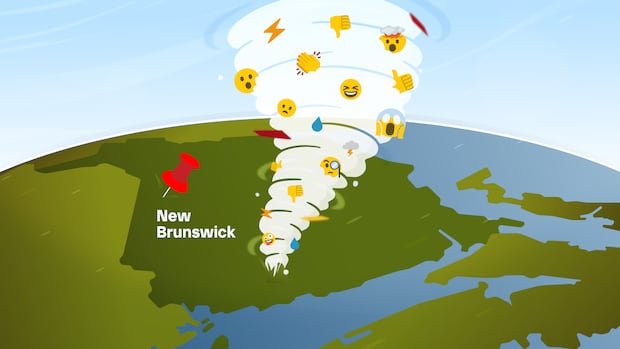

Environment Canada issued a severe thunderstorm watch for New Brunswick on July 14, indicating favorable atmospheric conditions for thunderstorm development. The watch also mentioned a potential tornado risk.
Although no severe thunderstorms or tornadoes occurred, a wave of misinformation spread on social media, causing panic with unreliable images. Sander van der Linden, a psychology professor at the University of Cambridge, noted that extreme weather events are breeding grounds for misinformation due to their real-time nature, urgency, and uncertainty.
It’s important to differentiate between an Environment Canada “watch” and a “warning.” A watch advises preparedness for severe weather, while a warning indicates immediate action is necessary as severe weather is imminent or ongoing.
Fredericton-based meteorologist Jill Maepea clarified that the tornado risk was low when the severe thunderstorm watch was issued. Despite efforts to predict convective weather in advance, these storms can rapidly develop and dissipate, making them challenging to track accurately.
The social media uproar criticizing Environment Canada for not issuing a storm notice earlier escalated even after the watch was posted. Misinterpretations led to false claims of tornado warnings circulating online, further fueling the misinformation frenzy.
Van der Linden emphasized the importance of clear communication during emergencies, as ambiguous messages can sow confusion and alarm. The aftermath of the storm watch saw continued misinformation spread, with AI-generated images adding to the challenge of discerning real from fake content.
Aaloak Jaswal from the University of New Brunswick highlighted the ease of spreading misinformation with AI technology, emphasizing the need to verify sources and information authenticity. Repeated exposure to convincing AI-generated content poses a risk, potentially eroding trust in official communications during emergencies.
In such uncertain times, building trust and preemptively debunking misinformation within communities can help combat the spread of false information. Van der Linden advocated for a community-led approach to ensure a healthy information diet and promote safety during emergencies.