

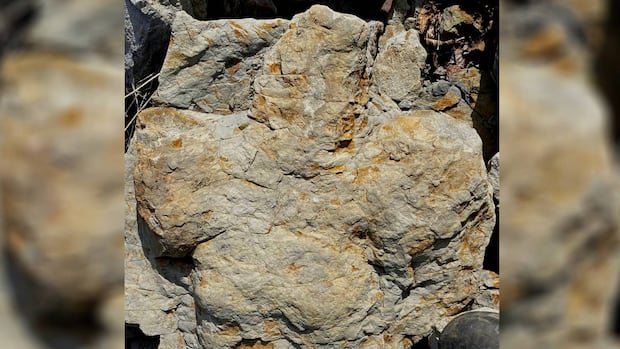

In 1988, Guy Plint, an earth scientist, was conducting sedimentary research in Tumbler Ridge, British Columbia, analyzing formations that dated back 86 million years. During his study, he accidentally discovered tracks left by duck-billed dinosaurs. Fast forward nearly forty years, the region in northeast B.C. has become a UNESCO Global Geopark renowned for its wealth of ancient fossils.
Collaborating with a local paleontologist, Plint delved into the history of the discovered tracks. He highlighted that these tracks are the northernmost ones documented in North America, with the closest similar tracks of this age found in southern Montana.
Recently, Plint and Dr. Charles Helm, a local physician and paleontologist, co-published new research on the tracks. Their findings revealed that the fossilized footprints belong to the Coniacian age, dating back to the Late Cretaceous period, approximately 85 to 89 million years ago.
The research indicated a shift in dinosaur species during that period, with duck-billed dinosaurs replacing ankylosaurs as the prevalent herbivores. These changes coincided with the emergence of flowering plants as a food source. The tracks were discovered in what was once a prehistoric delta in Tumbler Ridge, bordering an inland sea.
Plint emphasized that these tracks are the only known Coniacian age dinosaur tracks in Canada. During explorations in 2022, 2023, and 2025, five individual tracks were recovered and are now part of the Tumbler Ridge Museum’s collection. The research paper described these tracks as offering a rare glimpse into a past thriving dinosaur community.
Eamon Drysdale, the museum’s resident paleontologist and curator, mentioned that they have taken measures to protect the tracks found by Plint and Helm. He highlighted the significance of these tracks in understanding the transition between dinosaur species during the Cretaceous period, where certain species became extinct, making way for new groups to dominate.
The discovery sheds light on the evolution of dinosaurs at that time, providing valuable insights into the changing dynamics of prehistoric ecosystems.