

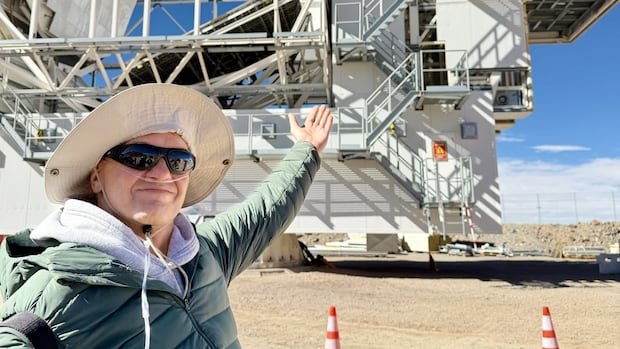

A cutting-edge telescope, situated at an extreme altitude in Chile’s Atacama Desert, represents a groundbreaking collaboration involving Canadian researchers. This Fred Young Submillimeter Telescope, perched at 5,600 meters above sea level, exceeds the base camp of Mount Everest in elevation. The telescope’s high placement in the arid desert ensures an unobstructed view, free from atmospheric interference.
According to Mike Fich, an astronomer at the University of Waterloo and lead of the Canadian team, the telescope offers unparalleled clarity akin to space-based observations but at a fraction of the cost. With a wide field of view, the instrument can swiftly scan and map vast portions of the sky, enabling researchers to delve into the mysteries of star and galaxy formation, dark energy, dark matter, and the origins of the universe.
The project, spearheaded by Cornell University’s CCAT Observatory in New York, in partnership with Chilean, German, and Canadian universities, involves a network of Canadian institutions such as the University of Toronto, the University of Alberta, McGill University, and McMaster University. The telescope’s innovative design allows for the installation of multiple instrument modules, facilitating technological upgrades as they emerge.
Notably, the telescope’s advanced quantum sensor cameras, engineered by Scott Chapman’s team from Dalhousie University, the University of British Columbia, and the National Research Council, operate at extremely low temperatures near absolute zero. These cameras can detect submillimeter wavelengths of light, revealing cold gas clouds where stars originate. By observing stars in the Milky Way and distant galaxies, the telescope provides a glimpse into the past, tracing the evolution of galaxies in the early universe.
The Fred Young Submillimeter Telescope project, costing approximately $40 million, requires dedicated computing centers to handle the vast data output. Construction challenges due to the remote high-altitude location necessitated innovative solutions like a dedicated power station and specialized logistics for transporting heavy components to the site.
Despite the demanding conditions, researchers are eager for the telescope to yield groundbreaking discoveries as it starts collecting data this summer. The findings, expected to be shared with the public within a year, hold the promise of unveiling new insights into the cosmos.