

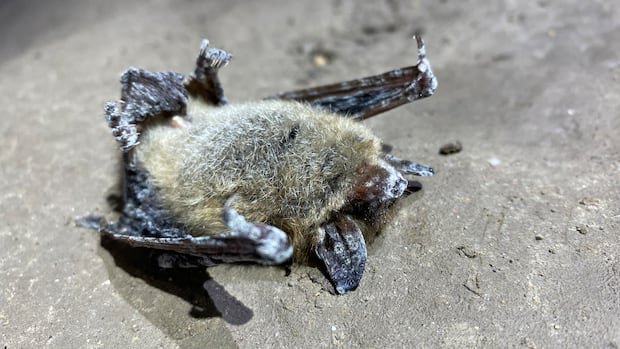

Parks Canada teams are actively engaged in Alberta’s bat caves, dispersing a mixture of bacteria to combat a lethal and rapidly spreading fungal disease threatening the survival of flying nocturnal mammals. Nina Veselka, a biologist at Parks Canada, has witnessed the devastating impact of the outbreak in a cave within Jasper National Park, where bats weakened by the infection have fallen from the cave walls and faced challenges in their survival on the cave floor. The potential consequences are dire, with the risk of local extinction looming over the cave.
The menace, known as white-nose syndrome, poses a significant threat to Alberta’s entire population of hibernating bats. The syndrome is triggered by a fungus that thrives in cold, damp environments like bat caves, infiltrating the bats’ tissues. Manifesting as a fuzzy, white growth on their snouts and wings, the fungus disrupts the bats’ hibernation, depleting their crucial fat reserves that cannot be replenished during winter, thereby exposing them to the risk of starvation.
Although the fungus does not endanger humans, it can decimate up to 98% of a bat colony. During a visit to the cave in March, Veselka and the ecological monitoring team from Parks Canada discovered approximately a dozen deceased bats near the entrance of a Jasper National Park cave hosting a hibernating bat colony. Subsequent counts revealed around 69 dead bats, a stark increase compared to the three deceased bats recorded in each of the previous two years.
The locations where white-nose syndrome has been identified in other Alberta bat caves, including Cadomin, the largest known hibernation site for bats in the province, have been under scrutiny. Efforts are underway to combat the spread by introducing probiotics that combat the fungus at the entrances of maternity roosts in Jasper and even within confirmed roosting spaces. Veselka explained that these probiotics contain four bacterial strains proven to inhibit the growth of the white-nose-causing fungus, aiming to impede its proliferation on the wings, tails, and faces of bats.
In Alberta, the probiotics are being applied as a treatment for the disease, while in British Columbia, where the infection has not taken hold, they are being used as a preventive measure. This proactive approach instills a glimmer of hope, indicating that there are viable actions to take rather than conceding defeat. The fungus responsible for white-nose syndrome, initially detected in Europe in the early 1900s, spread to North America, causing widespread bat fatalities. Alberta encountered the syndrome in 2022.
Veselka and her team tallied 615 bats in March and emphasized the vulnerability of bat populations in Alberta and the Rocky Mountains due to their small numbers. The potential spread of the fungus among bats could lead to a surge in infections, with consequential impacts on insect populations, including mosquitoes and agricultural pests. Lisa Wilkinson, a biologist and bat specialist for the Alberta government, highlighted the prolonged recovery time for bat populations, as they typically produce only one pup per year. She mentioned ongoing research and treatment efforts using probiotics in various sites to combat the syndrome but acknowledged the absence of a definitive solution to prevent, cure, or eradicate the fungus.