

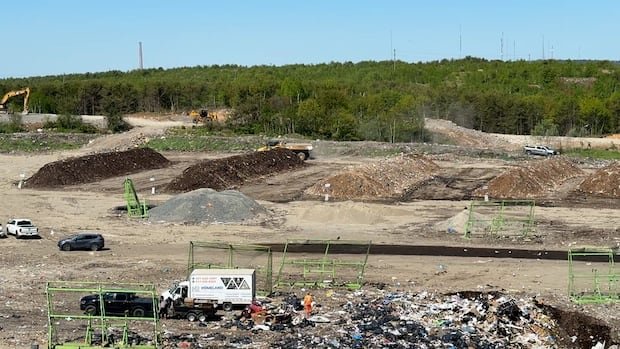

The City of Greater Sudbury predicts that its three landfills will reach capacity in approximately 25 years if current disposal habits persist. Renée Brownlee, the city’s environmental services director, highlighted that 30% of landfill waste consists of organic materials that could be redirected to compost piles. However, only 40% of eligible low-density households participate in the city’s green bin program.
Since its inception in 2009, the green bin program saw a participation rate of only 27% of eligible households in 2018. This figure rose when the city enforced a two-bag limit for bi-weekly garbage collection. While the blue and green bin pickups occur weekly, Brownlee emphasized the need for increased organic waste diversion.
According to Brownlee, a potential new landfill could cost a minimum of $200 million and necessitates approval from the Ontario Ministry of the Environment, Conservation, and Parks, a process that could span over a decade. Considering the costly nature of an incinerator, with Ottawa contemplating a $450 million project, maximizing waste diversion becomes crucial.
Brownlee mentioned that diverting all possible materials would effectively double the current landfill lifespan. To enhance green bin program participation, the city contemplates two strategies. The first involves mandating clear garbage bags for household waste, a low-cost initiative proven to boost diversion rates. However, this proposal faced resistance from some city councillors due to privacy concerns.
The second option entails implementing a pay-per-use system, where residents pay for each garbage bag utilized. Apart from extending landfill life, promoting green bin usage aligns with reducing the city’s greenhouse gas emissions. Unprocessed organic waste emits methane, a potent greenhouse gas, emphasizing the importance of proper waste management practices.
While the city harnesses methane for electricity production, further improvements are necessary. Finished compost undergoes rigorous testing for safety before being distributed for public use. Compost meeting quality standards is available for gardening, while the remainder is repurposed for industrial applications like mining operations.