
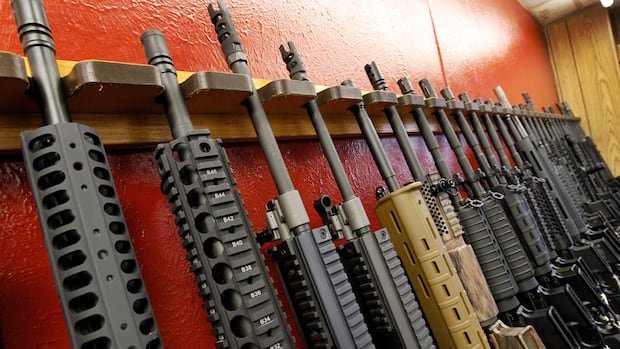

More than 7,000 banned weapons were declared by Albertans as part of the federal government’s gun buyback initiative, as reported by Ottawa on Wednesday. Despite this, uncertainty looms over the compensation process due to disagreements over jurisdiction, with Alberta’s chief firearms officer indicating that it is the federal government’s responsibility to resolve. Public Safety Canada disclosed that a total of 67,000 prohibited firearms were declared by 37,869 owners nationwide by March 31, with Alberta accounting for 7,334 of the declared weapons, ranking fourth behind Ontario, British Columbia, and Quebec.
Ottawa has prohibited around 2,500 firearms, contending that so-called “assault-style” guns are primarily intended for combat rather than hunting or sports shooting. Owners of banned firearms were given until March 31 to voluntarily declare them. The fate of Albertans who participated in the program remains uncertain, as the province has opposed it, instructing all provincial bodies, including law enforcement agencies, to refrain from implementing the buyback program citing provincial sovereignty legislation.
Minister of Justice Mickey Amery affirmed Alberta’s decision not to partake in the federal firearm confiscation program, criticizing it as costly and ineffective in enhancing public safety. Quebec has supported the program, but other provinces, including Saskatchewan, have also resisted it. Federal Public Safety Minister Gary Anandasangaree expressed disappointment over the resistance, noting that law-abiding citizens enrolled in the program may not be eligible for compensation as a result.
Teri Bryant, Alberta’s chief firearms officer, rebuffed Anandasangaree’s remarks, emphasizing that Alberta cannot be compelled to aid in actions it disagrees with. Public Safety Canada announced that it would begin evaluating declarations this month, with individuals set to receive further instructions in the ensuing weeks. Collection appointments are slated to be conducted by the RCMP, a mobile unit, or local police, with specific rules varying by region and complying with provincial laws.
Andre Reed, president of the Hanna Rod and Gun Club, expressed surprise at the high number of Albertans who declared their firearms. The buyback scheme has sparked discussions among gun owners, many of whom are closely monitoring the October deadline, by which prohibited firearms must be disposed of or deactivated to avoid criminal liability. Reed criticized the program as government overreach, echoing sentiments of frustration among responsible gun owners.
PolySeSouvient, a gun control advocacy group, deemed nationwide participation in the program “disappointing” but not catastrophic, highlighting conflicting views on the matter. Noah Schwartz, a political science assistant professor at the University of the Fraser Valley, described the current situation as uncharted territory for Canada, emphasizing the lack of clear planning and collaboration between the federal and provincial governments in implementing the buyback initiative.
The standoff between advocacy groups, governmental bodies, and gun owners has intensified, with legal challenges and resistance shaping the landscape of gun policy in the country. The Supreme Court of Canada has agreed to hear arguments against the firearm ban, reflecting the escalating tensions surrounding the issue.