


Andrea Bear Nicholas has dedicated more than 21 years to documenting the history of Bilijk, also referred to as Kingsclear First Nation, through her research and writings.
The publication, titled Bilijk, chronicles the community’s history from the 1780s up until 1950 in a chronological framework.
This work is a compilation of oral histories, archival materials, artwork, and photographs that Bear Nicholas, a historian, has accumulated over the years.
Some of her discoveries have been quite startling, according to Bear Nicholas.
“It’s shocking to learn that parents of children who didn’t attend school could face imprisonment or fines,” remarked Bear Nicholas, a member of Neqotkuk, also known as Tobique First Nation.
She has gathered accounts from government reports, church members, and other settlers detailing their perspectives on the community.
“It’s essential for people in our communities to be aware of what has been said about us. The narratives told by individuals from each community can be derived from these documents, and that becomes their narrative,” she explained.
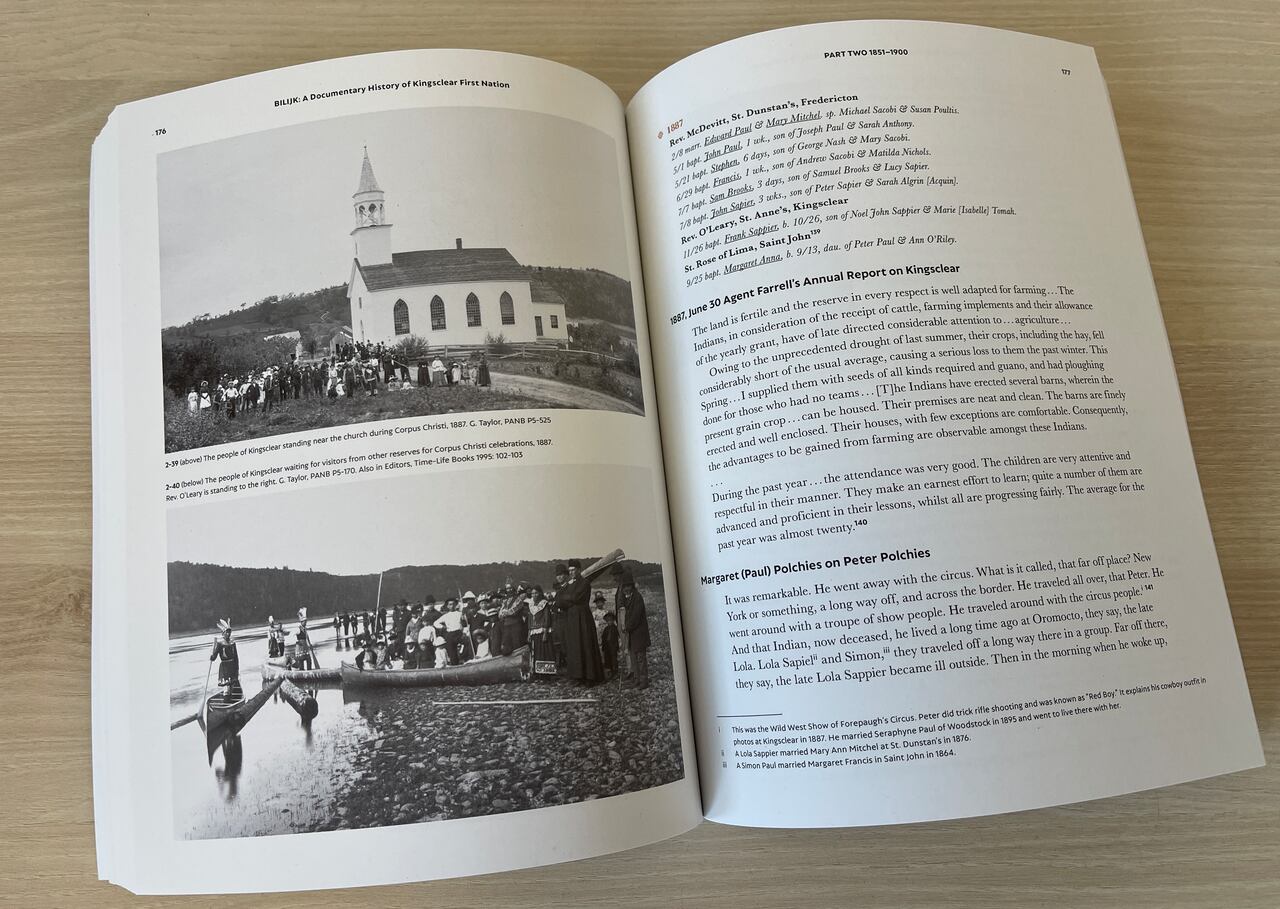
The Bilijk book provides a historical account of the community, showcasing photos from 1887 of local residents alongside a government report and a story from the same year. (Oliver Pearson/CBC)
Additionally, the book features firsthand testimonials from community members recounting their experiences and observations of their peers.
Bear Nicholas expressed her deep commitment to Wolastoqey history, stating she “couldn’t just remain passive” regarding her findings.
“Our youth have not been educated about our history; they attend school and predominantly learn Canadian history,” she noted.
She chose to include derogatory language in her writing for specific reasons, asserting that omitting it would fail to reflect the genuine sentiments of the era. She explained that the presence of such language illustrates the true mindset of that time.
“By removing it, you would essentially be sanitizing the actual thoughts of the settlers and government officials regarding us,” she remarked. “Those discriminatory terms encapsulated their views and emotions towards Indigenous peoples.”

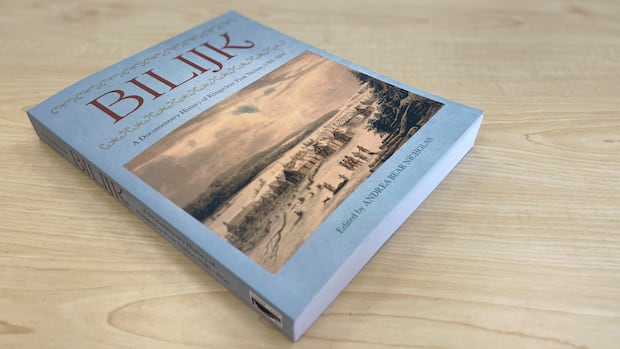
A painting by John Campbell from 1832 depicting Kingsclear, featured on the cover of the Bilijk book. (Library and Archives Canada)
The introduction of the book reveals the original name of the land—Ekwpahak, signifying “end of the tide,” as the community lies upriver from the Bay of Fundy, west of Fredericton.
Subsequently, readers can navigate through a series of narratives and documents, each linked to specific dates and, in some cases, the names of their authors.
Bear Nicholas traveled extensively to gather information, visiting France, London, and various locations across the U.S. to explore museums and archives.
She even discovered a journal in France written by a priest who served the community in 1794.
Additionally, she found evidence indicating that at one point in the early 1800s, the community’s population surpassed that of the nearby French Village, an Acadian settlement.
Bear Nicholas emphasized the importance of focusing on Bilijk as it is the first community in the province, likely representing the oldest established reserve in the region.

Historian Andrea Bear Nicholas shares insights on her newly completed book about the history of the Wolastoqey community of Bilijk, or Kingsclear First Nation.
Bear Nicholas mentioned that the provincial government has agreed to distribute free copies of the book to households in Bilijk.
She is also in the process of translating the book into Wolastoqey and is working on additional books focusing on the histories of Woodstock, Oromocto, and Saint Mary’s, or Sitansisk, First Nations.
The Bilijk book can be purchased through Goose Lane Editions, a Fredericton-based publisher.