

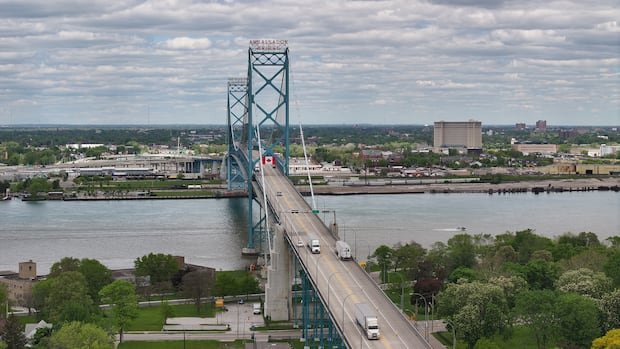

Canada’s most active trade route has discreetly shifted its focus northward. High toll fees at the Ambassador Bridge have steered a surge in commercial traffic towards the Blue Water Bridge, leading the Sarnia crossing to surpass Windsor as the busiest commercial crossing on the Canada-U.S. border after many years.
According to Alexandre Gauthier, the communications manager for the Federal Bridge Corporation Limited (FBCL), the Blue Water Bridge has now outpaced all other international crossings in commercial traffic volume. FBCL, a government-owned corporation that manages border crossings, including the Blue Water Bridge, reported that in 2025, the Sarnia crossing recorded about 2.1 million commercial truck trips compared to around 1.9 million at Windsor, based on data from the Bridge and Tunnel Operators Association.
This trend continued into 2026, with the Blue Water Bridge surpassing the Ambassador Bridge in commercial truck trips during the first three months of the year. The toll discrepancies play a significant role in reshaping trade routes. Commercial truck tolls at the Ambassador Bridge, reaching up to $27 per axle, are nearly four times higher than the $7 per axle at the Blue Water Bridge and the proposed $12 per axle rate for the Gordie Howe Bridge.
Stephen Laskowski, President and CEO of the Canadian Trucking Alliance, highlighted the impact of toll prices on supply chains. The toll gap has redirected trade flows northward to Sarnia, altering one of North America’s key trade corridors. The delays in the completion of the Gordie Howe International Bridge, coupled with cost overruns, have further complicated the situation.
Despite being heralded as a transformative project, the Gordie Howe Bridge faces uncertainties with no firm opening date in sight. Delays have led to substantial financial losses, with estimates suggesting potential weekly losses of up to $7 million USD. The project, originally budgeted at $5.4 billion, is now forecasted to cost around $6.1 billion, significantly exceeding initial projections.
Matti Siemiatycki, a geography and urban planning professor at the University of Toronto, discussed the challenges associated with public-private partnerships (P3) in infrastructure projects. The P3 model, once popular for infrastructure development, has faced criticism for not consistently delivering projects on time and within budget. Risks associated with such projects often lead to government intervention and increased costs.
Concerns over the delays and rising costs of the Gordie Howe Bridge have prompted inquiries to Infrastructure Canada and the Windsor-Detroit Bridge Authority, yet responses are pending. Similarly, attempts to seek comments from the Ambassador Bridge regarding toll increases and traffic shifts have not yielded a response.