

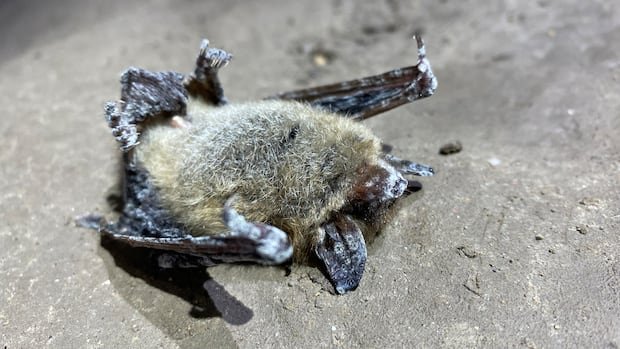

A lethal fungus that has devastated bat populations across North America is spreading in Alberta, with recent detections in the Rocky Mountains marking a significant expansion of the disease in the province. White-nose syndrome, caused by a fungus infecting bats’ skin during hibernation, has resulted in the deaths of over 6.7 million bats in North America since 2006. The fungus forces bats to wake up from hibernation, leading to starvation, dehydration, and eventual death.
Recent surveys conducted by the provincial government and Wildlife Conservation Society Canada discovered evidence of white-nose syndrome in three caves in the Rockies, including the Cadomin and Wapiabi caves in central Alberta. These caves have been closed to the public since 2010 to prevent the spread of the disease among hibernating bats. The exact location of the third cave with infected bats is being kept confidential to discourage visitation.
Lisa Wilkinson, a provincial bat specialist, expressed concern over the significant decline in bat populations due to the disease, with an estimated 80% decrease observed in a recent survey. She highlighted the vulnerability of hibernating bat species like the little brown bat and northern myotis, both considered endangered by the federal government.
Efforts to combat white-nose syndrome include the use of probiotic treatments, with the province initiating applications last year. The treatment involves spraying bat houses with a bacterial cocktail during the summer, showing promising results in reducing fungal presence on bats and facilitating the spread of the probiotic among bat populations.
While complete eradication of the disease may be unlikely, conservationists remain hopeful that by helping more bats survive hibernation without contracting the disease, the impact of white-nose syndrome can be mitigated. Public participation is crucial in bat conservation efforts, with initiatives such as reporting bat roosting sites and submitting bat guano for testing aiding in monitoring and treatment strategies.
Cory Olson from the Alberta Community Bat Program emphasized the importance of raising awareness and appreciation for bats to garner community support for conservation efforts. By dispelling misconceptions and promoting bat conservation, the program aims to protect bat populations and combat the threat of white-nose syndrome.