

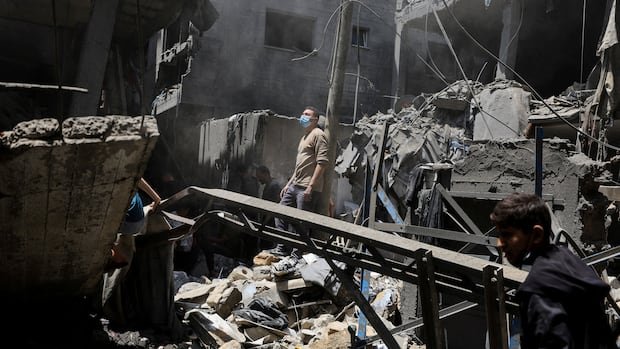

Nickolay Mladenov, the lead official supervising the ceasefire agreement in Gaza facilitated by the U.S., emphasized on Wednesday that the success of the truce depended on Hamas disarming. This particular issue has hindered progress in various areas, including the reconstruction efforts in the heavily damaged region.
Mladenov, representing U.S. President Donald Trump’s International Board of Peace in Gaza, expressed concern over the lack of advancement in implementing the agreement, stating that the delay was detrimental to both Israel and the Palestinians. He highlighted that the key obstacle was Hamas’s failure to comply with the disarmament requirement, describing it as a non-negotiable condition. The impasse on this front was preventing progress on crucial matters such as reconstruction, Israeli troop withdrawals, and the formation of a new Palestinian government.
During a briefing with international journalists in Jerusalem, Mladenov stressed the importance of not allowing armed groups to control the streets, operate from tunnels, or stockpile weapons, as it impedes the region’s future development. He warned that without Hamas disarming, Gaza would face prolonged suffering.
Although Hamas has agreed to disarm as part of the ceasefire, little progress has been made in this regard. The group has linked its demilitarization to Israeli troop retreats, as Israel still maintains authority over a significant portion of Gaza.
Mladenov, following a meeting with Israeli Prime Minister Benjamin Netanyahu, acknowledged the challenges in implementing the ceasefire agreement. He noted the ongoing dire conditions for the over two million inhabitants of Gaza, particularly those living in makeshift camps along the coastline where essential resources are scarce, leading to health hazards such as rodent infestations.
Addressing the ceasefire violations by both sides, Mladenov underscored the critical nature of disarmament. Hamas, with its historical stance of armed resistance against Israel, has been hesitant to relinquish its weapons, including rockets and explosives.
Mladenov criticized Hamas for consolidating power in certain areas of Gaza to gain leverage in negotiations. However, he also highlighted the potential for Hamas to play a role in post-conflict Gaza once it disarms, emphasizing the importance of the group renouncing armed activities to participate in Palestinian elections.
The situation remains tense between Israel and Hamas, with accusations exchanged on various violations post-ceasefire. Efforts to execute the phased ceasefire plan, involving weapon handovers by Hamas, Israeli troop pullouts, and reconstruction, have faced obstacles, prolonging the instability in the region.
As tensions persist, reports indicate an escalation in Israeli attacks in Gaza since the pause in joint operations with the U.S. in Iran. The continued conflict underscores the fragility of the ceasefire, with both sides preparing for potential resumptions of hostilities.