

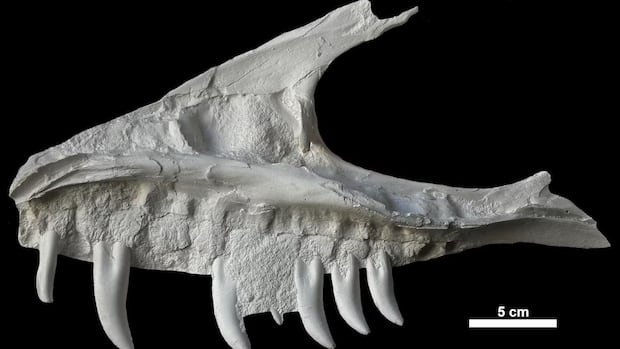

A recent study reveals that the fossilized skull unearthed at a British Columbia campground belonged to a lighter and faster tyrannosaur compared to the well-known T. rex. Researchers from the University of Alberta analyzed a cast of a partial skull imprint dating back 76 million years and identified it as belonging to a horned dinosaur named Gorgosaurus.
Their findings, detailed in the journal Palaeogeography, Palaeoclimatology, Palaeoecology, shed light on a species that once inhabited Western Canada, according to lead researcher Colton Coppock.
Coppock explained, “We were able to distinguish Gorgosaurus based on distinct characteristics observed in this imprint.”
According to the Royal Tyrrell Museum in Alberta, Gorgosaurus could grow up to nine meters in length.
Discovery near the riverbank
The process of identifying the dinosaur began in 2017 when local resident Rick Lambert stumbled upon an unusual rock at a Tumbler Ridge campground near the Alberta border during a hike. Lambert, who developed a keen eye for fossils in his youth in England, credited a squirrel for drawing his attention to the rock along the river’s edge.
Upon examination by a paleontologist from the Tumbler Ridge Museum Foundation, it was confirmed that Lambert had discovered British Columbia’s first tyrannosaurus skull.
“Although we possess abundant dinosaur materials here, bone remnants are scarce,” explained museum curator Eamon Drysdale, noting that the original sandstone-block etching of the impression is meticulously preserved at the museum.

A well-preserved relic
The fossilized skull imprint contained remnants of the dinosaur’s upper jaw, known as the maxilla. Despite the erosion of most bone material, the imprint was sufficiently preserved to enable researchers to craft a detailed cast showcasing the skull’s unique features.
Coppock recalled that his supervisor presented him with the cast at a barbecue last August, and he immediately recognized it as likely belonging to Gorgosaurus libratus.
This species existed 76 million years ago, predating its more famous relative, the T. rex, by about 10 million years.
“It’s akin to T. rex’s great-uncle,” Coppock remarked.
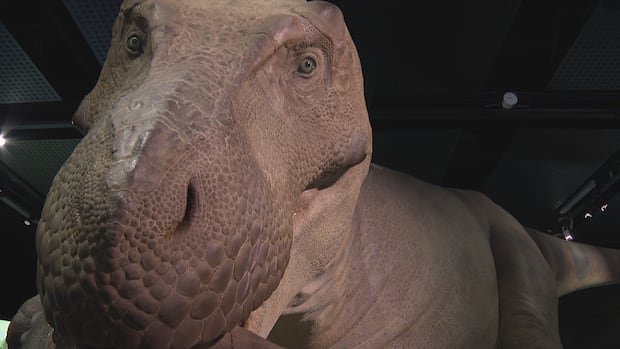
Although both dinosaurs shared similar features such as short forelimbs and elongated tails, Gorgosaurus sported triangular horns above its eyes, Coppock pointed out.
Describing them as “more lightly built tyrannosaurs with elongated limbs,” Coppock likened Gorgosaurus to a swifter version of the T. rex.
Examining the internal maxillary surface through the cast enabled Coppock and his colleagues to compare it to