

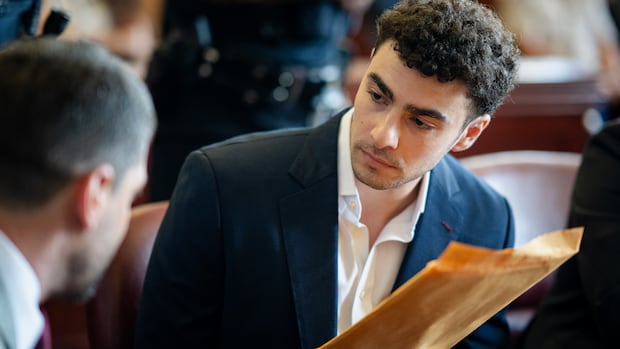

In a surprising turn of events, Luigi Mangione’s attorneys informed a judge on Thursday that he will no longer pursue a psychiatric defense in his state murder trial concerning the death of UnitedHealthcare CEO Brian Thompson.
This announcement came just a day after Mangione’s legal team notified Judge Gregory Carro of their intention to argue that the 28-year-old Ivy League graduate was experiencing severe emotional distress during the incident on December 4, 2024.
A request for comment was sent to a representative for Mangione’s lawyers, while the Manhattan district attorney’s office, handling the prosecution of the state case, opted not to provide a statement.
Mangione’s lawyers were under a deadline on Thursday to supply prosecutors with evidence supporting the emotional disturbance argument.
In another development, Carro retracted his decision to make public a transcript and other documents from a confidential hearing held on June 3, referencing the defense’s recent choice. However, by the time of his decision, copies of the transcript had already been distributed to some media outlets.
The transcript did not reveal any new information regarding the emotional disturbance argument.
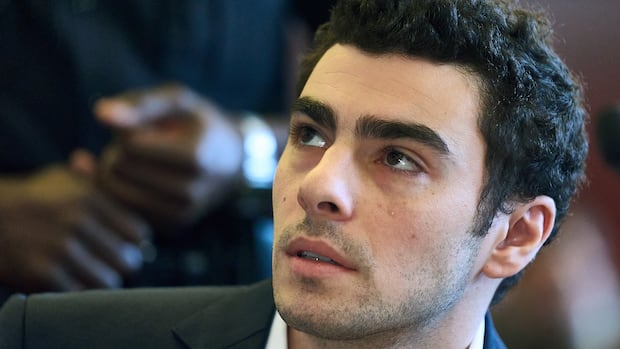
A federal judge in New York has dismissed a murder charge against Luigi Mangione, accused of killing UnitedHealthcare CEO Brian Thompson in 2024. U.S. District Judge Margaret Garnett found the charge technically flawed. Mangione will still face federal stalking and firearms charges, as well as a separate state murder charge.
Had Mangione proceeded with the extreme emotional disturbance defense, it would have constituted an admission of guilt regarding Thompson’s death, while arguing that extenuating circumstances warranted such actions. This approach would not have absolved him of accountability but could have resulted in a lighter sentence.
If a jury accepts this defense, they would be compelled to convict the defendant of manslaughter, which carries a maximum sentence of 25 years, as opposed to murder, which could lead to a life sentence.
Defense ‘respectfully withdraws’
In a correspondence to Carro on Thursday, Mangione’s attorney Karen Friedman Agnifilo stated that the defense “respectfully withdraws” its notice under New York’s psychiatric defense law “at this time.”
At 28 years old, Mangione has pleaded not guilty to both state and federal charges. His state trial is set to commence on September 8, while his federal trial, which includes stalking allegations, is scheduled for October 13.
During Wednesday’s session, Friedman Agnifilo objected to Carro’s ruling to unseal documents related to his psychiatric defense, asserting that it would be “prejudicial to his defense to the exact same facts” in his federal case, where such a defense is not permissible.
It is important to note that an emotional disturbance defense is distinct from a not guilty by reason of insanity defense, which could lead a defendant to a psychiatric facility instead of prison.
Thompson, aged 50, was shot as he approached a Manhattan hotel for UnitedHealth Group’s annual investor conference. Surveillance footage captured a masked assailant attacking him from behind.
Mangione, an Ivy League alumnus from an affluent Maryland family, was apprehended five days later at a McDonald’s in Altoona, Pennsylvania, roughly 370 kilometers west of Manhattan.
In a ruling last month, Carro decided that a firearm and a notebook, which prosecutors claim connect Mangione to the murder, may be utilized as evidence against him.
The firearm, identified as a 3D-printed pistol, is claimed by prosecutors to match the weapon used in Thompson’s murder.