

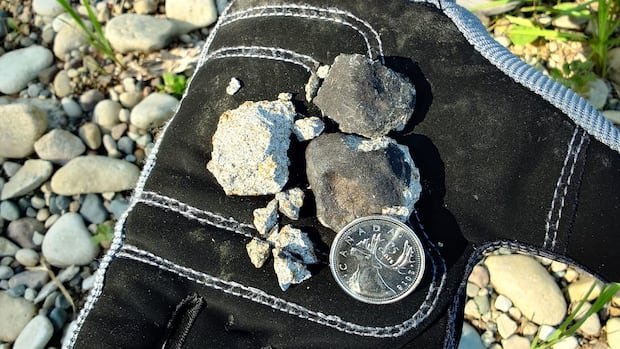

Meteorite fragments from a significant fireball witnessed over the skies of northern Ontario last month have been found on Cockburn Island in Lake Huron. The discovery was made by Dave Kenny and Anton Clemens, members of the volunteer group Meteorite Recovery Specialists. Cockburn Island, situated off the western side of Manitoulin Island in Lake Huron’s North Channel, is a sparsely populated area.
Samples from the recovered meteorite fragments were analyzed by the Meteor Physics Group at Western University in London, confirming their origin from June 19 when a massive meteor disintegrated in the atmosphere and landed on Earth. This discovery holds special significance for Kenny, as it marks his first meteorite recovery on Canadian soil.
Accessing the island was a challenging task due to most of it being private or protected land. Kenny had to coordinate with the Cockburn Island council and the Nature Conservancy of Canada to determine the search areas. They reached the island by boat from Meldrum Bay on Manitoulin Island and spent two and a half days combing through the terrain.
During their search, the team covered almost 50 kilometers on foot and found multiple meteorite fragments. The largest piece, weighing 57.6 grams, was discovered intact by the roadside. Another fragment was found broken into pieces two kilometers south of Tolsmaville on the island. The recovered stones are suspected to be chondrites, a common type of meteorite originating from the asteroid belt between Mars and Jupiter.
The primary fragment has been sent to Western University for further study, with Kenny mentioning that it will undergo a six-month analysis. Despite not being formally classified yet, these meteorite pieces hold significant scientific value and add to the understanding of celestial events.