

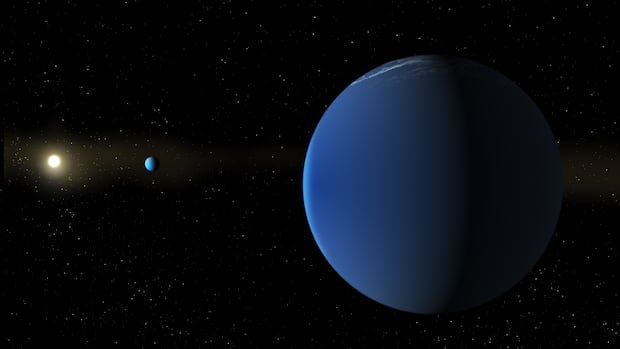

Researchers have discovered two “super-puff” exoplanets about 1,113 light years away from Earth, orbiting a single star. These planets, with Jupiter-like size but cotton candy-like density, are a rare find in the universe. The study, led by University of Oxford astrophysicist George Dransfield, describes these unique celestial bodies as resembling a blob of shaving foam.
The mystery of how these massive yet low-density planets form remains unanswered. Co-author Antoine Petit, a mathematician at France’s Centre National de la Recherche Scientifique, highlighted the need for further theoretical work to understand their unusual characteristics. Published in the Monthly Notices of the Royal Astronomical Society, the findings shed light on these enigmatic “super-puff” planets.
Super-puffs, a rare category among over 6,300 confirmed exoplanets, pose a challenge to conventional planetary formation theories. The presence of two super-puffs orbiting the same star adds to the intrigue of this discovery. The planets’ unusual characteristics suggest there might be internal mechanisms responsible for their puffed-up appearance.
Scientists speculate that the super-puffs could be young or maintained at a high temperature, causing their gas composition to expand and increase their size. The possibility of tidal heating or other heat sources keeping these planets inflated raises further questions about their evolution and formation processes.
Detected by NASA’s Tess satellite, these super-puff planets, named TOI-791 b and TOI-791 c, orbit a star in the Volans constellation. Follow-up observations using NASA’s Webb Space Telescope are crucial to confirm the planets’ composition. The sibling planets, exhibiting a gravitational connection, have intrigued researchers with their shared characteristics and orbital dynamics.
While ongoing research may challenge current conclusions, scientists anticipate that studying these unique planets will offer valuable insights into planetary evolution. The discovery of these super-puffs opens new avenues for understanding the complexities of celestial bodies in our universe.