


A sell-off in technology shares worsened on Friday amid concerns that Wall Street’s excitement surrounding artificial intelligence technology has inflated prices excessively.
The S&P 500 fell approximately 1.8 per cent, marking its most significant decline since June. The downturn in tech stocks led the Nasdaq composite to decrease by 2.9 per cent, while the Dow Jones Industrial Average slipped by 1.1 per cent.
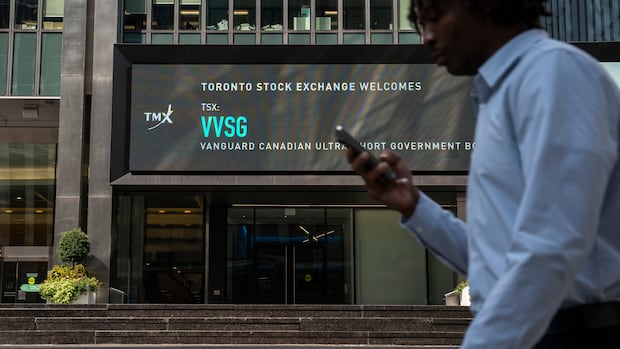
Canada’s primary index, the S&P/TSX composite, rebounded from a 2.3 per cent drop in the afternoon to finish down 1.7 per cent.
Intel’s shares took a significant hit, plummeting 28.6 per cent, representing its largest drop since 1974. The chipmaker’s profit forecast for the last quarter of the year fell short of what analysts had anticipated, with CEO Lip-Bu Tan noting ongoing pressure in the personal-computer sector. This decline occurred despite Intel reporting stronger-than-expected profits for the most recent quarter.
Amazon’s stock dropped 1.4 per cent after revealing summer profits that disappointed analysts. More troubling for investors was the company’s announcement that it had burned through $42.4 billion USD in cash over the past year, according to a metric known as free cash flow. Amazon allocated $94.8 billion USD for property and equipment, predominantly for investments in artificial intelligence technology.

Andrew Chang breaks down how Anthropic’s unique ownership structure works as the AI giant prepares to go public — and why it’s nearly impossible to overrule its founders.
On the previous day, Alphabet’s stock experienced a decline of over 12 per cent, marking its worst day on record, which significantly contributed to the S&P 500’s drop after announcing it used more cash during the summer than in the spring. The parent company of Google and YouTube cited substantial investments in AI.
Fears are escalating regarding whether the massive investments totaling in the hundreds of billions of dollars will yield sufficient profit and productivity to justify the costs. Concurrently, shares of semiconductor companies and other beneficiaries of the rush to establish AI data centers are facing pressure amid concerns that elevated interest rates might hinder further development of these centers.
“We’re transitioning from the hopes and dreams stage of the AI trade into the ‘show me’ phase,” commented Joe Tigay, portfolio manager at Equity Armor Investments, in a communication to investors.
Nvidia, the chip company synonymous with the AI boom, saw a 4.2 per cent decline, serving as a major factor pulling the S&P 500 down, surpassing even Intel’s impact.
In the cryptocurrency sector, stocks fell following a hack on the largest crypto exchange globally. Bitcoin’s price dropped to around $77,000 USD from over $86,000 USD earlier this month, with a U.S.-based blockchain intelligence firm indicating that a North Korean group was likely responsible for the breach that compromised more than $6 billion USD worth of crypto at Binance.
Outside the tech sector, stocks displayed more resilience, with many rising after reporting summer profits that exceeded analysts’ expectations. Nearly as many stocks in the S&P 500 index increased as decreased.

As investors pour billions into artificial intelligence, warnings of a looming AI bubble are intensifying. Andrew Chang breaks down what’s fuelling those fears. Plus, how one reporter’s question struck at the core of U.S.-Saudi relations.
ExxonMobil increased by 2.2 per cent, while Chevron rose by 1.8 per cent after both oil companies reported summer profits that surpassed analysts’ forecasts.
Mondelez International saw a 3.9 per cent increase due to stronger than anticipated growth, and Colgate-Palmolive climbed 2.3 per cent after higher product prices enabled it to achieve better revenue and profit than predicted.
Expectations remain high for U.S. companies’ capacity to generate larger profits, despite global concerns over soaring inflation and elevated fuel prices. These expectations are what propelled the S&P 500 to a record earlier this month.
In the bond market, Treasury yields softened, indicating that investors were purchasing U.S. government bonds as a safer investment. The yield on the 10-year Treasury dropped to 4.93 per cent from 4.98 per cent late Thursday and from over 5.30 per cent earlier in the month.
Globally, stock markets experienced mostly negative trends in Europe after more volatile movements in Asia. South Korea’s Kospi fell due to concerns regarding AI, while Hong Kong’s Hang Seng saw a slight increase.