

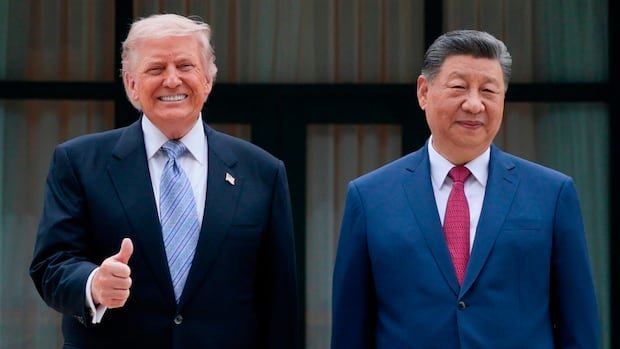

The recent highly anticipated meeting between the leaders of the United States and China concluded with cordial exchanges and handshakes, emphasizing ceremonial aspects over concrete outcomes. President Donald Trump and President Xi Jinping highlighted achievements in their discussions but provided minimal details on tangible results.
Trump expressed enthusiasm for the trade deals made, heralding them as beneficial for both nations. This positive stance on trade with China marks a shift for Trump, who previously criticized the country for causing job losses in American manufacturing.
While Trump’s portrayal of the summit emphasized economic gains for the U.S., analysts scrutinizing public statements struggled to identify substantial changes. The meeting appeared to prioritize managing existing issues rather than resolving them, as noted by Rush Doshi, director of the China Strategy Initiative at the Council on Foreign Relations.
Key challenges, such as the trade war and supply of rare-earth minerals, were discussed but without clear indications of significant breakthroughs. Trade lawyer Mona Paulsen advised caution in interpreting public statements until formal actions are taken.
The only specific agreement announced during the summit was China’s commitment to purchase 200 aircraft from Boeing. Market reaction to this limited deal was mixed, with Boeing’s stock price declining post-announcement.
A crucial outcome dubbed “strategic stability” emerged from the summit, signaling a positive shift in U.S.-China relations, according to Yun Sun, director of the China program at the Stimson Center. The establishment of a “Board of Trade” and “Board of Investment” was announced, aiming to enhance trade relations and potentially reduce tariffs.
While the summit hinted at future developments, concrete details may emerge in the following weeks, including potential Chinese investments in the U.S. and tariff adjustments. Trump’s engagement with Chinese companies and the focus on stability in relations suggest a new phase of negotiation between the two nations.
Amidst discussions on economic cooperation, uncertainties persist regarding the U.S.’s strategic approach towards China, especially in light of Trump’s historic emphasis on decoupling the two economies.
The evolving dynamics between the U.S. and China reflect a broader trend of negotiation and stability-seeking, underscoring the complex interplay of economic interests and geopolitical factors in the ongoing dialogue between the two superpowers.