

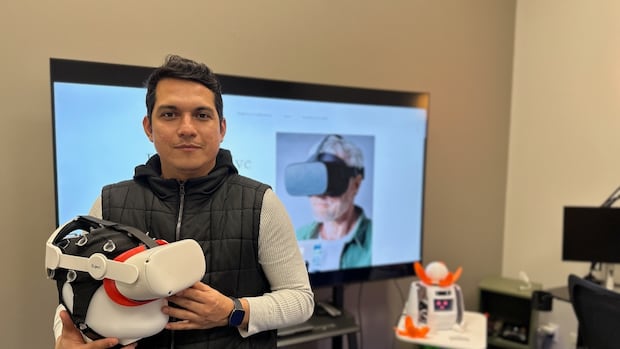

At the Adult Recreation Therapy Centre in Brantford, Ontario, some seniors living with dementia can partake in activities like fishing, rowing, and tai chi, all thanks to the innovative efforts of researchers from Wilfrid Laurier University.
John Muñoz, a professor specializing in user experience design, along with his students, is creating exercise video games—known as exergames—that participants can engage with through virtual reality.
“For those who are restricted to certain environments or who can’t participate independently, this provides an excellent chance to immerse them in a different reality than their current one, while promoting physical activity,” Muñoz stated in an interview with CBC Hamilton from his lab on Laurier’s Brantford campus.
Supported by funding from the Alzheimer Society: Brant, Haldimand Norfolk, Hamilton Halton, Muñoz and his team collaborated with Brantford’s Adult Recreation Therapy Centre to trial a game designed to facilitate therapeutic movements and stimulate cognitive engagement.
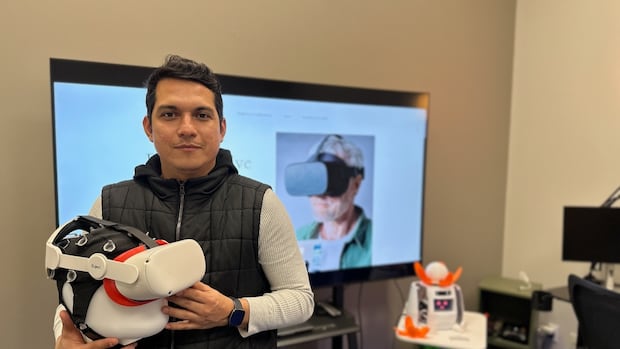
John Muñoz, a professor of user experience design at Wilfrid Laurier University in Brantford, Ont., explains how his lab is using exercise video games to help older people with dementia. He demonstrates some of the games and shares how he sees the field evolving over time.
Muñoz’s motivation stemmed from his grandmother’s experience after suffering a stroke, which made it difficult for her to stay motivated during her physiotherapy sessions.
“I believed there had to be an alternative way to keep individuals active and engaged in their recovery process while still performing exercises,” he remarked.
His team is currently seeking volunteers for a 10-week program, where participants will be observed during two weekly 20-minute gaming sessions, gathering data on their reaction times and memory capabilities.
He noted that recruitment has proven more challenging than anticipated, indicating that some older adults may have reservations about video games.
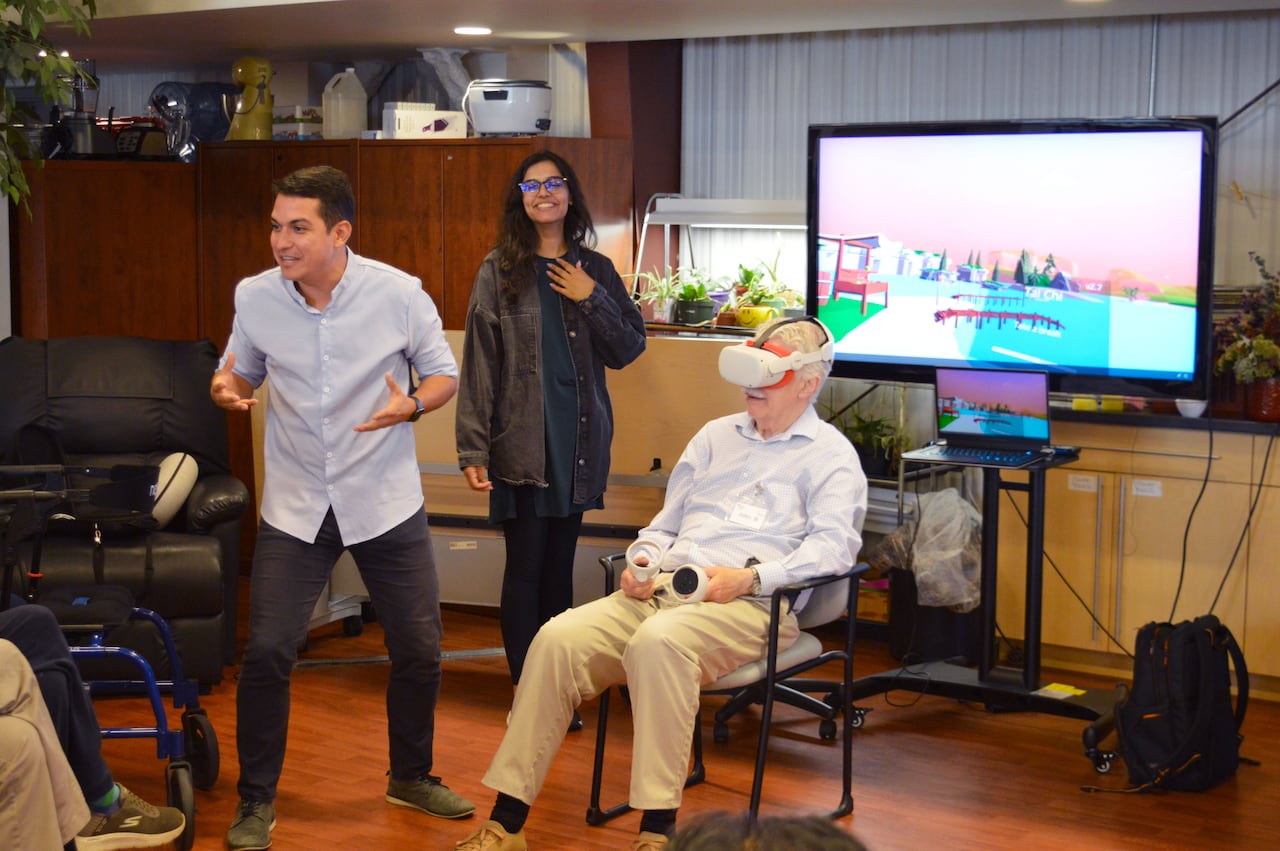
An audience at the Adult Recreation Therapy Centre watches someone play Seas the Day, seeing what he sees on the screen behind him. (Submitted by Wilfrid Laurier University)
In his lab at Laurier’s Brantford campus, Muñoz demonstrates the game Seas the Day. With VR headsets and two controllers, players use arm movements to mimic fishing and rowing actions.
According to Muñoz, crucial to user experience design is incorporating feedback from users during development, particularly when creating games for an audience that may not be well-versed in gaming.
“Our games do not resemble complex first-person shooters or fantasy titles, which could present difficulties in understanding game mechanics for older adults,” Muñoz explained.
-
Researchers want to know how people with multiple sclerosis might be helped by playing Tetris
-
‘If you can’t move, you can still game’ — how a developer helps make accessible video games
Instead, the team consulted potential participants about activities they missed and designed the games accordingly. Muñoz mentioned that many expressed a longing for experiences by the lake.
Additionally, they aimed to make Seas the Day accessible.
For instance, participants are not required to master complex controls or button presses. Muñoz noted that some users naturally played the rowing game by pushing their arms forward to move, despite needing to row in the opposite direction. To enhance usability, they included an option to invert the rowing controls for a more intuitive experience.
Muñoz highlighted the significant potential of exergames, observing that baby boomers are among the last generations who did not grow up with video games. Many of the seniors he encounters were casual gamers at some point, making them “more receptive to the notion that games can serve purposes beyond mere entertainment,” he added, forecasting this trend will likely continue.
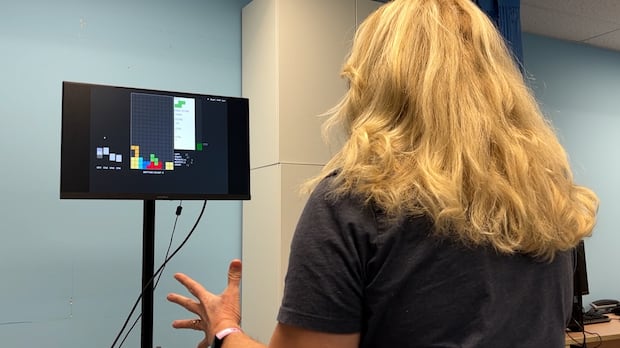
A study that aims to improve balance in people with multiple sclerosis is ongoing at McMaster University in Hamilton. The study has people hooked up to a computer and play classic videogame Tetris with their body.
The future of exergames
Muñoz expressed his aspiration that the technologies developed by him and his students will extend beyond the lab and be widely embraced “by those who truly need them.”
His BioAdaptive Interface Lab is also engaged in creating games for pediatric healthcare, while other teams are exploring their applications in various health-related research.
For instance, researchers at McMaster University recently discussed a study utilizing Tetris to assist individuals with multiple sclerosis in staying active.
At that time, participant Diane Bouwman remarked that playing the classic game with motion controls provided a fun way to remain active.
“I’m really focused on [the video game], and I’m not preoccupied with [how to move]. This is the game, and I’m fully engaged,” she noted.
Muñoz envisions a bright future for exergames.
“I foresee a time when dedicated gaming rooms will be commonplace in residences or long-term care facilities, featuring not just entertainment-focused games, but also those purposefully designed to keep residents physically and mentally stimulated.”