

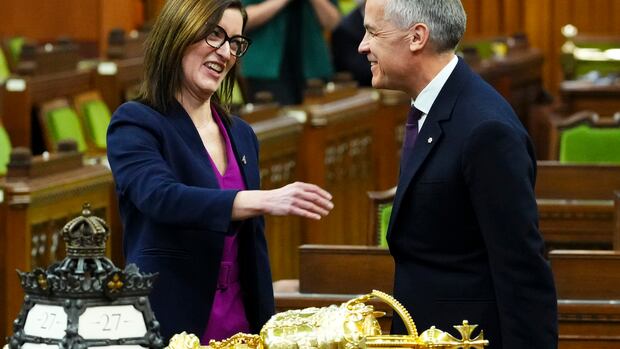

The trio of Liberals who emerged victorious in the byelections that granted a majority government to Prime Minister Mark Carney earlier this month took their places in the House of Commons on Monday.
In a swift move to capitalize on its new majority powers, the government proposed a motion aimed at restricting debate regarding an adjustment to the House rules, which would allow the Liberals to gain control over committees.
The Liberals intend to modify the committee composition to ensure they hold a majority of seats. These committees are responsible for examining legislation and other government activities and possess the authority to summon witnesses and demand the submission of documents.
Steven MacKinnon, the government House leader, stated that these changes are in line with the “long tradition” in Parliament whereby majority governments also maintain a majority presence on committees, although he acknowledged that this situation is somewhat uncommon.
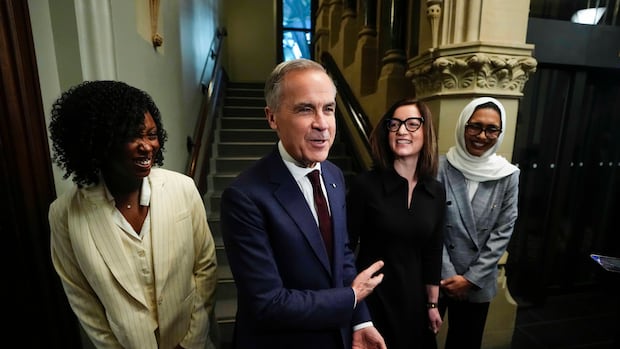
Prime Minister Mark Carney participated in the parliamentary tradition of escorting his party’s three newly elected MPs into the House of Commons chamber on Monday. Returning MP Tatiana Auguste and new MPs Doly Begum and Danielle Martin each claimed seats in federal byelections earlier this month, contributing to the Liberals’ majority government.
“It is rare for governments to shift their status to achieve a majority of seats in the elected chamber during a standard mandate,” he remarked.
Opposition House leader Andrew Scheer criticized the initiative as undemocratic.
“The very first vote that these new Liberal MPs will cast will be one to curtail debate. So welcome to the Liberal Party of Canada, you can leave your principles at the door and simply adhere to whatever the whip instructs you,” Scheer stated.
Despite opposition, the Liberals possess sufficient voting members to push through the changes.
The government benches now comprise 174 members following the defection of five MPs—four from the Conservative party and one from the NDP—over the past six months.
On Monday, Doly Begum, Danielle Martin, and Tatiana Auguste took their seats after being formally sworn in as members of Parliament on Saturday.
-
Analysis
The important questions raised by Parliament’s game of musical chairs
-
Opposition parties cry foul over Liberal move to seize control of committees
-
Liberals will move to take control of House committees with newly secured majority
Begum and Martin are new faces who succeeded outgoing cabinet ministers Bill Blair and Chrystia Freeland in seats located in the Toronto area.
Auguste secured a seat in the Bloc Quebecois stronghold of Terrebonne after winning a rematch, following the Supreme Court of Canada’s decision to nullify the results of last April’s election in that riding. The court found that Elections Canada made a mistake in the printed return addresses on some mail-in ballots, resulting in a re-vote.
Auguste improved her one-vote win from 2025 to over 700 votes this time.
Most members of the Liberal caucus gathered in the Commons chamber to warmly welcome their new colleagues with standing ovations and some hugs.
In contrast, the opposition benches were sparsely populated with no more than two dozen MPs, and none of the party leaders were present.
The newcomers’ arrival coincided with the announcement from NDP MP Alexandre Boulerice that he would be leaving the party to serve as an Independent MP before resigning to pursue a provincial run with Quebec Solidaire this fall.
His departure leaves the New Democrats with only five seats in Parliament. The party’s new leader, Avi Lewis, is not an MP.
“I’m not bothered by this,” Lewis stated on Monday, noting that Boulerice had begun contemplating the shift to provincial politics long before his own leadership selection.
A byelection must be scheduled within six months of Boulerice’s resignation from his riding of Rosemont-La Petite-Patrie.