

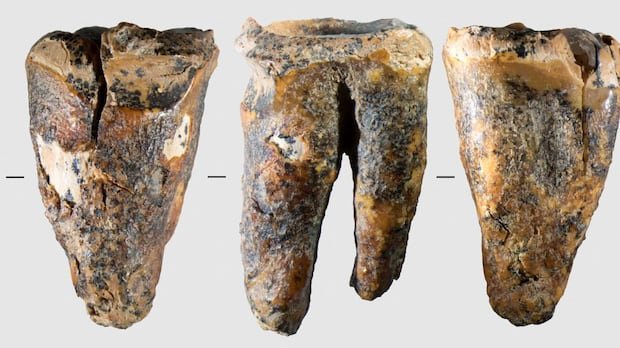

About 59,000 years ago, a Neanderthal residing in the Siberian mountains experienced severe dental pain and took action to address it. Recent findings indicate that a lower molar found in a cave in the Altai Mountains region exhibited signs of dental work, with a large hole seemingly drilled manually using a stone tool to remove decay.
The study, detailed in the journal PLOS One, marks the earliest-known instance of invasive dental surgery, predating recorded evidence of homo sapiens treating cavities. This discovery adds to the mounting proof that Neanderthals were more advanced than previously assumed.
Anthropologist John Olsen, a study co-author, proposed two scenarios for how the Neanderthal sought relief from the toothache. He suggested that either the individual sought external assistance due to the intense pain or attempted self-treatment by drilling the tooth with a stone tool, though the latter appears less probable given the Neanderthals’ social nature.
While the existence of Neanderthal dentists is doubtful, the precision of the tooth modification hints at a skilled medical practitioner’s involvement. The fossil, belonging to an unidentified adult, was excavated at Chagyrskaya Cave in Russia, a significant site for Neanderthal fossils.
Further analysis confirmed that the dental intervention was intentional, not accidental, or due to wear-and-tear. Experimentation on modern human teeth replicated the hole’s shape and microscopic features by utilizing a stone tool akin to those found in the cave.
This groundbreaking discovery challenges the belief that complex medical procedures were exclusive to modern humans. It showcases the Neanderthals’ cognitive capabilities, including planning, fine motor skills, and deliberate medical strategies, highlighting their sophistication.
The study’s findings underscore the need to reassess the conventional perception of Neanderthals as primitive beings. Recent research has revealed their artistic, tool-making, hunting, and caring abilities, contradicting previous stereotypes.
The significance of the Neanderthal tooth study lies not only in their potential medical knowledge but also in their communication skills. Enduring such a painful procedure without modern pain relief necessitated effective communication to convey the long-term benefits to the patient, challenging misconceptions about Neanderthals’ intellectual capabilities.