

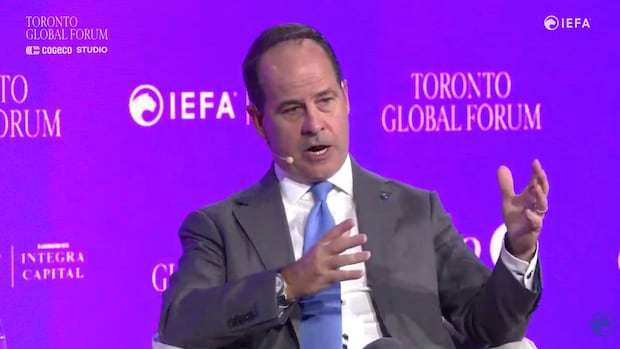

Bank of Montreal’s CEO Darryl White has voiced concerns regarding the trustworthiness of artificial intelligence agents when it comes to handling personal banking details.
During his address at the Toronto Global Forum on Wednesday, White highlighted his apprehensions about the rapid advancement of AI outpacing regulatory measures and safeguards. His statements followed those made by RBC’s CEO on Tuesday, who mentioned the possibility of restricting Meta’s well-known Muse AI agent from accessing customer data at his institution.
White remarked, “For 25 years, we have adapted to an e-commerce environment where we feel at ease.” He mentioned that this comfort has led some users to “freely input all my personal information anywhere, into any agent.”
He further cautioned, “Do not share your banking username and password. Avoid giving your credit card information. Do not disclose your social insurance number. Keep your PIN private. These details are not safeguarded.”
“I believe we still have a long way to go in terms of educating the public.”
In recent years, Canada’s major banks have poured billions into artificial intelligence. In August, White proudly noted that BMO’s insurance sector utilizes AI to make underwriting decisions in as little as 10 seconds, a significant reduction from the previous industry norm of 28 days.

If you’ve been searching for a home in Ontario, you may have come across some listings where the furniture appears a bit off. This is due to many of these being virtually staged with AI. Experts point out both advantages and disadvantages. CBC’s Talia Ricci explains what you should be aware of.
With a client’s consent, AI agents like Meta’s Muse and OpenAI’s ChatGPT are capable of linking to bank accounts and credit cards to track balances and transaction histories, as well as provide advice on spending habits. Typically, making purchases requires human consent.
On Tuesday, RBC’s CEO Dave McKay mentioned that his bank is contemplating the restriction of Muse from accessing customer information.
“It’s definitely something I’m considering,” he stated during a television interview with Bloomberg News.
“We’re not going to rush into a decision, but we must weigh consumer needs against the privacy and security of the system.”
Last week, the leaders of JPMorgan Chase & Co. and Charles Schwab announced their decisions to block or limit the use of external AI agents in accessing their clients’ data.