

This article is part of Mind Your Business, a weekly examination of significant business developments sent to subscribers on Monday mornings. If you haven’t subscribed yet, you can do so by clicking here.
Currently, the Canadian economy is grappling with two separate challenges.
Firstly, inflation levels are elevated and continuing to climb. Up to this point, price hikes have primarily been limited to the energy sector. Last month, inflation rose to 3.1 percent, while core indicators (which exclude more erratic factors) remained stable.
However, as demonstrated in the U.S., this containment is not permanent — once inflation spreads to other areas, it becomes challenging to control.
Conversely, the economy is showing signs of weakness, and we have yet to fully assess the effects of the latest round of tariffs.
These two conflicting crises present a complex dilemma for the Bank of Canada.
Typically, slow economic growth would lead the central bank to lower interest rates to encourage growth. However, with inflation on the rise, the bank may feel compelled to increase rates to temper the economy and manage price increases.
Two issues — with opposing solutions.
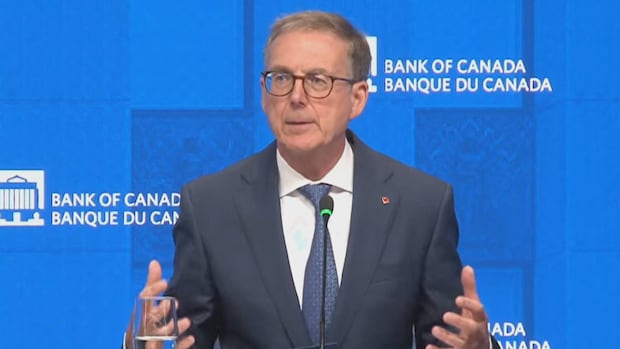
Bank of Canada governor Tiff Macklem expresses that while he hopes for a return to a ‘more normal’ Canada-U.S. relationship, he does not expect to revert to ‘where we were’ under an American administration that supports tariffs and protectionism.
One by one, most prominent economic organizations in the country have revised their predictions. The consensus is that the Bank of Canada will raise its key overnight lending rate on Wednesday.
They all present the economic reasoning behind this, but as Frances Donald and Nathan Janzen from RBC Economics point out, the bank is interpreting this year’s inflation surge in light of the previous inflation spike — the pandemic shock of 2022 to 2023.
“The cautionary lessons from the post-pandemic inflation surge … showed how supply-side shocks and persistent cost pressures can rapidly overwhelm an economy,” wrote Donald and Janzen in a recent client note.
Thus, many economists now anticipate a rate increase, even if not all agree it is the right course of action.
Donald and Janzen argue that a quarter-point hike wouldn’t significantly alter their outlook on the economy. (After all, they had based their forecasts on the expectation that rates would rise next year.)
“Ultimately, the implication of a rate hike on Oct. 28 carries a broader significance that we should not overlook: Central banks are less patient with inflation than in the past and are prepared to act preemptively to mitigate it,” they stated.
-
Bond yields are rising to levels not seen in decades. What does this mean for Canadian consumers?
-
Subscribe to Peter Armstrong’s weekly newsletter here
Ideally, if we could wish for an optimal sequence of economic data this week, we would prefer the interest rate decision to follow the GDP figures, which are set to be released on Friday.
GDP growth was stagnant in July (recording zero percent growth), and the economy is projected to have expanded by 0.1 percent in August. However, new tariffs came into effect during that month, which means the risks to the forecast remain skewed to the downside.
Uncertainty has become the new norm.
The Canadian economy and consumers have shown greater resilience than anticipated. Nonetheless, every new challenge chips away at Canada’s potential for growth.
On a more positive note, an update on the Bank of Canada’s economic forecasts will also be available this week. The Monetary Policy Report serves as the central bank’s thorough analysis of its economic outlook.