


Initially unveiled in 2022, the Pathways Alliance aimed to strike a balance between ongoing oil production in Canada and Prime Minister Justin Trudeau’s ambitious carbon emission reduction goals.
Now referred to as the Oil Sands Alliance, this initiative has united five major firms responsible for nearly all production in Alberta’s oilsands, focusing on emission reduction efforts. Their primary carbon capture initiative seeks to transport CO2 from around 20 oilsands facilities and permanently store it underground at a new site near Cold Lake, Alberta.
In essence, it was a form of social license—allowing the oilsands sector to continue oil extraction while investing in carbon capture technologies to mitigate their emissions.
However, four years later, the carbon capture initiative (still named Pathways) has become increasingly unclear regarding its environmental benefits and the funding sources involved.
“With millions of Canadians facing poor air quality [due to wildfires], we are directing more funds to the oil and gas sector for a pipeline that the industry won’t finance itself,” stated Tom Green, senior manager for climate solutions at the David Suzuki Foundation.
“Additionally, we have this Pathways project, which I would characterize as a rapidly diminishing fig leaf, meant to suggest that the oilsands industry is genuinely concerned about their emissions.”
Earlier this month, the federal and Alberta governments, along with the five companies in the Oil Sands Alliance, finalized an agreement to advance the carbon capture project, which aims to transport and sequester approximately six million tonnes of CO2 annually by the mid-2030s.
An additional 10 million tonnes in reductions is also targeted by 2045.
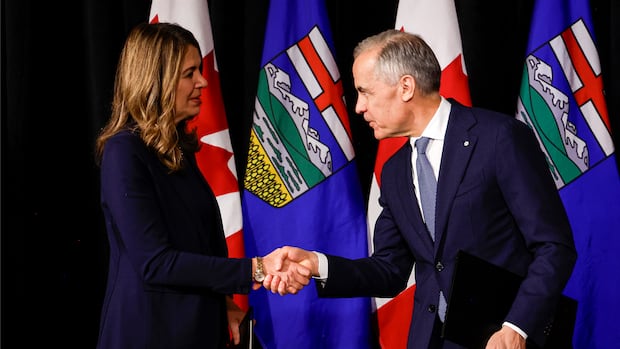
Prime Minister Mark Carney and Alberta Premier Danielle Smith have reached a climate and energy agreement that opens the door to work on a new pipeline to the B.C. coast as early as Sept. 1, 2027. It includes increasing Alberta’s industrial carbon emissions prices to $130 per tonne by 2040.
This represents a notable reduction from the oil companies’ original plan to capture 22 million tonnes of carbon by 2030. The oilsands currently release over 90 million tonnes of CO2 annually.
Under the terms of the agreement, the federal government has promised investment tax credits of 50 percent for carbon capture technology and 37.5 percent for related transportation and storage equipment. These credits have been extended until 2035.
More importantly, the federal government has pledged to provide additional financing and support to cover the operating expenses of Pathways even after its completion.
This appears to be “a very substantial … public support package for the oilsands, which is an exceedingly profitable sector and likely not the type of industry that Canadians would perceive as needing assistance,” remarked Janetta McKenzie, director of oil and gas at the Pembina Institute, an energy policy think tank.
McKenzie highlighted that in addition to the support for Pathways, the planned West Coast oil pipeline is expected to be 90 percent publicly funded. Furthermore, the Alberta government has indicated it will explore financial incentives to boost oil production itself, facilitating the filling of the new pipeline.
Assistance through carbon credits
A significant challenge within the existing carbon storage market is the pricing of carbon credits in Alberta—these are generated by businesses that achieve better-than-expected emissions reductions or establish their own carbon storage facilities. The concept is that these companies can sell their carbon credits to those exceeding their emissions limits, providing a financial motivation to lower emissions or invest in carbon capture.
McKenzie noted that this is how oil companies could potentially recoup their investments in a carbon capture initiative.
“In theory, one could generate carbon credits from the constructed carbon capture project and then sell those credits on the carbon credit market,” she explained.
The issue is that carbon credits in Alberta (known as TIER credits) were trading at around $35 per tonne at the start of this year, significantly lower than the official carbon price in Alberta of $95 per tonne.
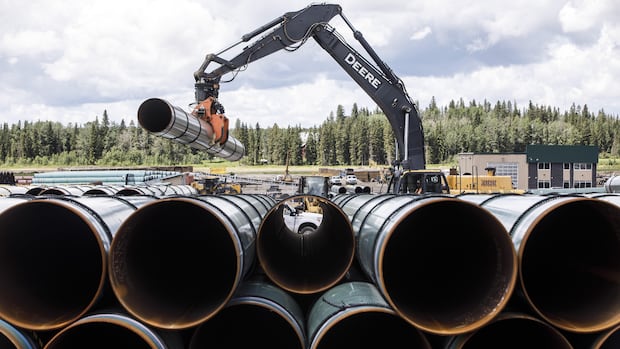
Alberta is expected to announce new details about its proposed West Coast oil pipeline later this week. Former Alberta Petroleum Marketing Commission CEO Richard Masson discusses what’s still unclear, including the route and private backing.
Kendall Dilling, president of the Oil Sands Alliance, shared with CBC Calgary’s Eyopener radio show that carbon capture initiatives do not generate profits independently.
“These projects are solely intended to lower emissions and enhance environmental outcomes. Therefore, governments and industries must collaborate to determine the correct financial sharing to render such initiatives feasible,” he stated.
According to Dilling, for the members of the alliance, the Pathways project is primarily advantageous as it would facilitate the construction of a new pipeline and enable oilsands companies to “significantly increase production again.”
He anticipates “some offsetting” of the Pathways operating costs through carbon credits.
An alternative to additional subsidies
Eric Chi, an economics professor at the University of Guelph, commented that the current carbon pricing represents a market failure, resulting in an oversupply of credits, which in turn makes emissions reduction projects—including carbon capture—unprofitable.
He suggested that to support the viability of carbon capture initiatives, the government could provide subsidies to keep them operational—similar to what has been proposed in the recent agreement—or heighten the emission reduction requirements for firms.
“For instance, if the initial requirement was to lower CO2 emissions by 100 tonnes, but we then increase it to 200 tonnes, companies would need to invest more to purchase these carbon credits,” which will increase in price due to heightened demand, Chi explained.
He recognized that there are “certain forces” that “will argue, ‘Hey, we can’t do that. The major opposition will come from oil companies that will resist such policies.”
This situation mirrors what occurred previously. In 2021, the federal government introduced its initial tax credits for carbon storage. Oil companies responded by stating that it was insufficient to enable the construction of Pathways, despite unprecedented profits in the oil sector.
At that time, Alex Pourbaix, the former CEO of the oilsands company Cenovus, indicated that Pathways would require ongoing governmental support for companies to proceed.
In their latest agreement, Alberta and the federal government have pledged to attempt to elevate the price of those carbon credits—aiming for a “minimum effective credit price of $130/tonne.” However, this may still fall short of what is needed to support a project as extensive as Pathways, which could require up to $30 billion.
Mackenzie asserts that oil companies ought to bear part of the financial burden to mitigate their pollution.
Otherwise, “oilsands firms continue to release pollutants into the atmosphere, Canadian taxpayers foot the bill, and there’s no motivation for oilsands companies to reduce their emissions or pollution levels.”
“This results in a continuous cycle of issues.”