


Sitting in his wheelchair, 48-year-old Lee Marten gazes at the computer screen in front of him, envisioning the movement of the cursor across it. Almost instantly, the arrow responds to his thoughts.
Marten, a sergeant with the Vancouver Police Department (VPD) currently on leave, uses the cursor to swiftly type on a digital keyboard, matching or even surpassing the speed of human fingers. Within moments, the latest Toronto Blue Jays score appears.
“It may sound like something out of science fiction,” he remarked. “But here I am, and it’s functioning.”
On May 20, Marten became one of the pioneering Canadian ALS patients to undergo a Neuralink brain implant as part of a clinical trial at University Health Network’s (UHN) Toronto Western Hospital. He stands as the 26th individual globally to experience this procedure, which targets individuals paralyzed due to ALS or spinal injuries. In Canada, at least two other quadriplegics have received the implant, and a dual American-Canadian citizen with ALS underwent the procedure in the United States.
Neuralink, owned by the controversial trillionaire Elon Musk, initiated the procedure, sparking criticism toward the hospital for its involvement in the trial. Despite this, Marten views the implant as an opportunity to enhance his quality of life and contribute to scientific progress that could benefit others.
“Receiving a terminal diagnosis leaves little to look forward to,” he expressed. “This may potentially improve the time I have left and allow me to pave the way for others facing similar challenges.”
Marten’s journey to diagnosis commenced in April 2022 when symptoms surfaced while he was on bike patrol with the Vancouver Police Department. Initially thought to be a cycling injury, his condition deteriorated, culminating in a diagnosis of ALS three years later, a condition that progressively impairs nerve cells in the brain and spinal cord without a known cure.
Debilitated by ALS, Marten has lost his ability to walk and will eventually face complete immobility, speechlessness, and reliance on external respiratory support. The variability in the disease’s progression weighs heavily on him, particularly the realization that he won’t witness his children, Rys and Carys, grow up.
Before his tenure with the VPD, Marten served as a sheriff and spent 14 years as a reservist in the Canadian Armed Forces. Encouraged by his wife, Lisa, who pursued potential life-extending treatments, Marten was enrolled in the Neuralink clinical trials after an ad caught her attention on social media.
Following a stringent screening process conducted by the Neuralink team over Zoom, Marten was swiftly selected for the procedure. Brimming with humor, Marten quipped about his transformation into a futuristic cyborg post-operation, emphasizing his readiness for the groundbreaking surgery.
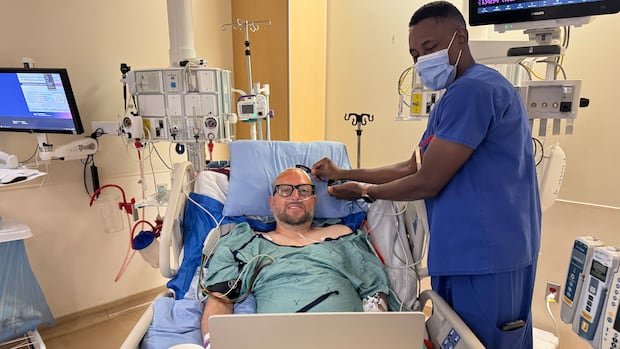
The surgery, lasting six hours, was deemed successful by the medical team. With 27 staples in his scalp and a throbbing headache upon awakening in the ICU, Marten swiftly engaged with Neuralink engineers to test the device, becoming the first participant to do so mere hours after surgery.
As they explored Toronto post-surgery, attending a Blue Jays game and visiting the Hockey Hall of Fame, Marten commemorated the experience with a tattoo on his leg depicting a human brain, the Neuralink symbol, and his patient number. Back in Vancouver, Marten diligently follows a post-operative regimen to monitor the device’s functionality, anticipating moments when he can create playlists for his children and engage in video games with them despite physical limitations imposed by ALS.
“This disease strips away everything from you,” Marten reflected. “But with resilience and adaptation, one can still make meaningful contributions.”