

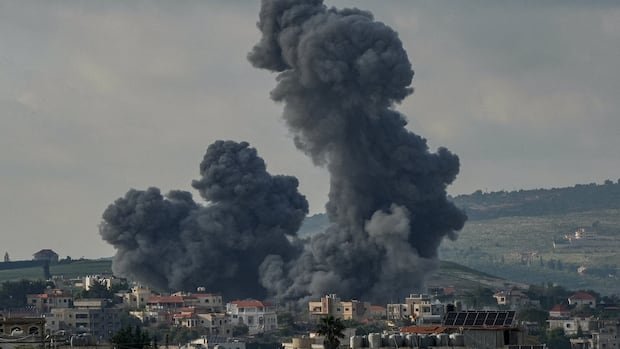

Israel conducted multiple airstrikes on southern Lebanon on Friday, resulting in the deaths of at least 10 individuals. Meanwhile, the militant group Hezbollah claimed responsibility for firing rockets and drones at northern Israel, injuring two soldiers. Both Israel’s military and Hezbollah continued their attacks despite a ceasefire in effect since April 17.
Israel’s military issued an evacuation warning to residents of the Lebanese village of Habboush near Nabatiyeh, urging those near Hezbollah’s facilities to move to safety. An airstrike in Habboush led to the death of six people, including a woman and a child, and injured eight others. Reports from the state-run National News Agency indicated that four individuals were killed in strikes on three additional southern villages.
Hezbollah released six statements by Friday afternoon, confirming their launch of drones and rockets at Israeli military posts. The Israeli military verified that Hezbollah deployed an explosive drone that landed near the Lebanon-Israel border. Israeli media reported drone strikes causing a fire and injuring two soldiers in the northern Israeli region of Margaliot.
The day’s clashes followed the retrieval of five bodies, including a man and his three sons, from beneath the rubble in Kfar Rumman village, near Nabatiyeh. The National News Agency stated that these individuals were killed in an airstrike the previous day. The Lebanese army confirmed the death of soldier Ali Jaber in the same incident.
Despite the ongoing conflict, southern Lebanon residents have been returning to their homes after being displaced for weeks. Umm Ali Khodor, whose apartment in Tyre was damaged in previous conflicts, expressed the challenges faced and the decision to return home due to difficult circumstances.
During the war, Red Cross volunteers were targeted, resulting in casualties and injuries. Xavier Castellanos Mosquera, an official with the International Federation of Red Cross and Red Crescent Societies, condemned the attacks on humanitarian workers. He highlighted instances of targeted facilities in Iran and Lebanon, emphasizing the risks faced by volunteers providing essential aid.
The recent escalation between Israel and Hezbollah began on March 2, with ongoing airstrikes and ground operations by Israel in southern Lebanon. The conflict has resulted in casualties and displaced populations. The two countries, historically in a state of war, engaged in direct talks after decades, with ceasefire efforts implemented and extended to mitigate further escalation.
As the death toll and injuries continue to rise in both Lebanon and Israel, the impact of the conflict remains a pressing concern for humanitarian aid organizations and international observers.