

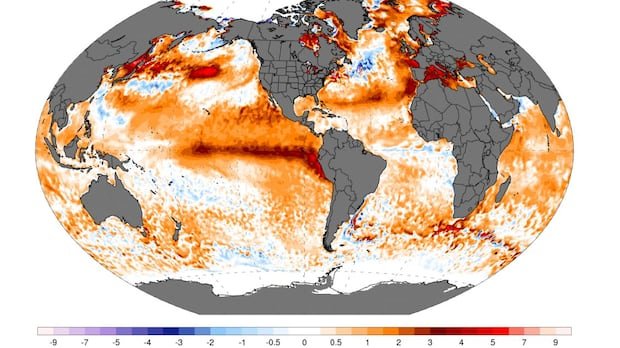

The highly anticipated El Niño has arrived, and it is already proving to be significant. Earlier this year, climate experts had predicted the development of an El Niño in the central Pacific region. Over time, more models started indicating a potentially strong or “super” El Niño, but scientists cautioned that it was too early to confirm. In its June update, the U.S. National Oceanic and Atmospheric Administration (NOAA) issued an El Niño advisory, confirming the warmer conditions in the specific region known as Niño 3.4 of the Pacific Ocean.
For an El Niño to be confirmed, temperatures in the Niño 3.4 region need to be 0.5°C above average. Currently, ocean temperatures are nearly 2°C above average, setting a record for this time of year. Zeke Hausfather, a climate scientist at Berkeley Earth, noted that the temperatures in the traditional Nino 3.4 region are already exceeding 2°C, indicating strong El Niño conditions even though it is only early July.
El Niño and La Niña are part of the El Niño Southern Oscillation (ENSO) cycle, affecting the Pacific Ocean region. While La Niña brings cooler temperatures, El Niño brings warmer temperatures. Hausfather mentioned that forecasts suggest the peak of this El Niño could be in October, with some models indicating November or December as more likely.
The most robust El Niño in recent years occurred in 2015-2016, with an ocean temperature anomaly of about 2.75°C. This rapid transition from La Niña to El Niño has raised questions about the speed of the change and its potential implications. Speculations about the peak temperature reaching 3.6°C have led to discussions about the role of climate change in these phenomena, although scientific consensus is still pending.
Concerns about the impact of El Niño on food security in tropical regions due to expected droughts and its effects on Canada, including milder winters but drier conditions leading to heightened wildfire risks, have been raised. Hausfather emphasized the seriousness of El Niño’s impacts on agriculture, natural ecosystems, and oceanic environments.