

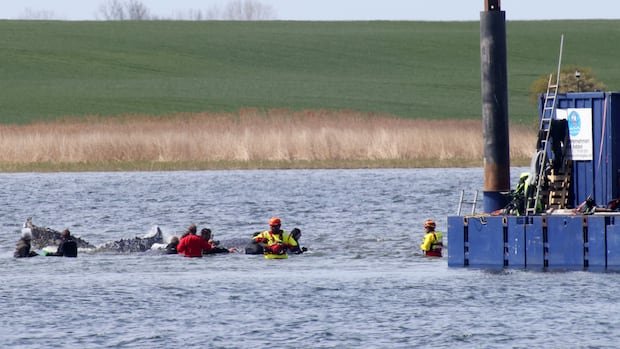

A deceased humpback whale discovered near a Danish island this week has been confirmed as the same whale that was rescued two weeks ago following multiple strandings off the German Baltic Sea coast. The whale washed ashore on Thursday near the small island of Anholt in the Kattegat strait, situated between Denmark and Sweden, linking the Baltic Sea to the North Sea. This location is south of Skagen, approximately 70 kilometers away, where the whale, known as Timmy and Hope, was released on May 2 after being transported by barge towards the North Sea.
Jane Hansen, a division head at the Danish Environmental Protection Agency, stated in an email that the stranded humpback whale near Anholt was positively identified as the same whale rescued in Germany. A tracking device still attached to the whale’s back was retrieved on Saturday, confirming its identity based on the device’s position and appearance.
Sadly, this discovery marked the conclusion of extensive efforts to guide the whale back to its natural habitat in the Atlantic Ocean. The whale was first sighted off the German coast on March 3, and despite rescue attempts in late March, it repeatedly encountered challenges in the Baltic Sea. The deteriorating condition of the whale sparked a contentious debate involving private rescue groups, regional authorities, and activists.
The cause of the whale’s death remains uncertain, with some experts suggesting that further rescue attempts could have caused the already distressed animal more harm. Despite a private rescue initiative’s efforts to aid the whale, it ultimately did not survive. Authorities in Mecklenburg-Western Pomerania emphasized the importance of learning from the incident, stating that the rescue attempt was a final opportunity for the whale to regain its health and freedom.
Plans for the deceased whale’s disposal are pending, with authorities cautioning against approaching it due to potential disease risks. Conservationists highlight disrupted migration patterns and human activities as contributing factors to whale strandings worldwide, underscoring the need for conservation efforts and awareness regarding marine wildlife conservation.