

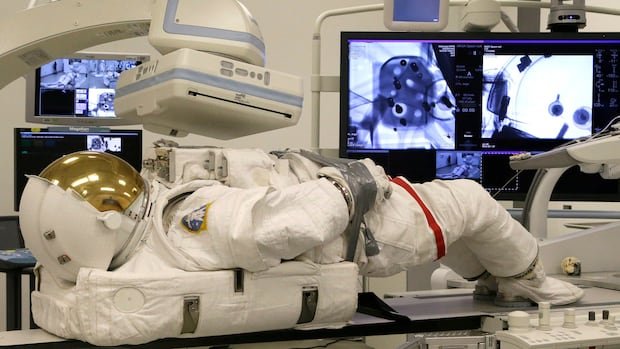

A variety of medical tools, such as the ear thermometer, portable ultrasounds for iPhones, and virtual doctor appointments, have roots in space technology adaptation. Experts anticipate that deep space exploration will introduce new healthcare innovations on Earth, focusing on portable medical devices and robotic care. These advancements are expected to be particularly advantageous for remote and underserved communities.
Dr. Dave Williams, a former emergency room physician and astronaut from Toronto, highlights the potential transfer of knowledge from lunar habitats to enhance remote medical care delivery in regions like northern Canada. Dr. Farhan Asrar, an associate dean at Toronto Metropolitan University’s school of medicine, collaborates with Williams to explore healthcare advancements related to deep-space missions, including upcoming ventures to the Moon and Mars.
As deep-space missions increase in duration and distance, the need for faster communication technologies for virtual care becomes crucial. Dr. Tarek Sardana, president of the Canadian Society of Aerospace Medicine, emphasizes the challenges astronauts face in accessing immediate medical care on Earth due to extended mission durations. Williams and Asrar stress the importance of incorporating robot- and AI-supported care to address time-sensitive health issues during deep-space missions.
Moreover, advancements in wearable technology, robotic limbs, and exoskeletons are on the horizon to monitor vital signs and support individuals at risk of falling or with disabilities. The evolution of space medicine also influences terrestrial healthcare practices, with portable medical technology playing a critical role in both space and remote Earth settings.
Despite the benefits of space medical innovations on Earth, the development and implementation of robotic and automated healthcare solutions face challenges such as cost and regulatory hurdles. Nonetheless, the recent Artemis II mission has sparked enthusiasm within the medical community, potentially accelerating innovation in aerospace medicine and attracting more professionals to the field.