

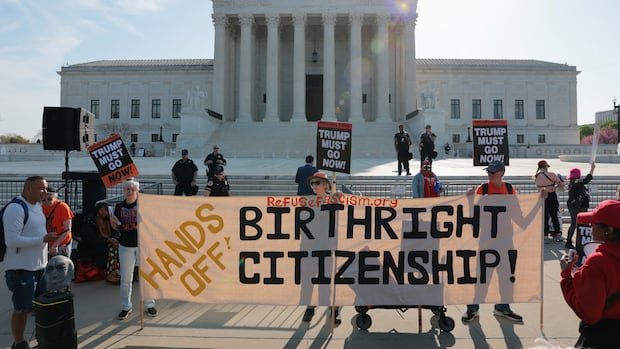

Supreme Court justices, in an unprecedented move with Donald Trump in attendance, deliberated on the legality of his executive order aimed at limiting birthright citizenship in the United States, a contentious aspect of his administration’s immigration policy.
During the hearing, the justices considered the Trump administration’s appeal against a lower court ruling that blocked the executive order directing U.S. agencies not to grant citizenship to children born in the U.S. if neither parent is an American citizen or legal resident. Both conservative and liberal justices scrutinized the Justice Department lawyer defending Trump’s action and posed tough questions to the attorney representing the plaintiffs challenging the directive.
Solicitor General John Sauer, representing the administration, argued at the outset that “unrestricted birthright citizenship goes against the norm in the majority of modern nations.” He highlighted that the U.S., along with Canada, is among approximately three dozen countries, mostly in the Americas, that offer unconditional birthright citizenship, as per research by the Global Citizenship Observatory at the European University Institute.
Trump’s executive order, issued on the first day of his second term, triggered class-action lawsuits from concerned parents and children. A New Hampshire court found that the order violated the citizenship provisions in the 14th Amendment of the U.S. Constitution and a federal law guaranteeing birthright citizenship.
Notably, Trump became the first sitting president to attend a Supreme Court oral argument. His administration’s stance is that granting citizenship to almost anyone born on U.S. soil encourages illegal immigration and birth tourism, where foreigners come to the U.S. to give birth for citizenship benefits.
The 14th Amendment, ratified post-Civil War, traditionally ensures citizenship for babies born in the U.S. with few exceptions. Chief Justice John Roberts challenged arguments seeking to limit birthright citizenship eligibility, emphasizing that the Constitution remains unchanged despite evolving times.
The administration contends that citizenship should be reserved for children whose parents’ primary allegiance is to the U.S., based on lawful domicile rather than mere birth on U.S. soil. This stance was questioned by Justice Amy Coney Barrett, raising concerns about defining citizenship in complex scenarios.
The ACLU attorney representing the challengers argued against Trump’s order, stressing the stability and importance of the 14th Amendment’s clear citizenship rule. The potential impact of a new precedent on the U.S. population and the rights of children born in the country without citizenship was a core concern during the hearing.
The Supreme Court, with a conservative majority, is set to deliver its ruling by June. The court has previously supported Trump on key immigration policies, including initiatives related to mass deportations and the removal of humanitarian protections for migrants.