

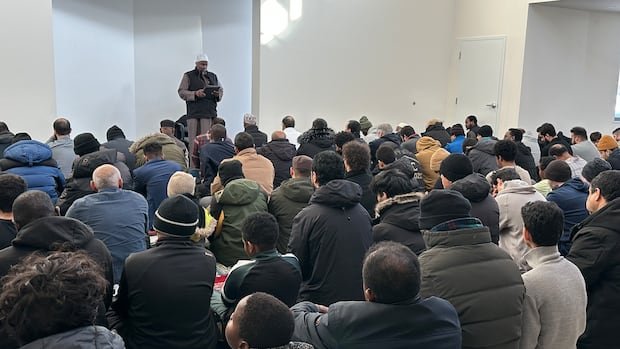

After spending years gathering in temporary locations, the Muslim community in Yellowknife has now established a permanent home at the newly built Islamic center in Old Town, coinciding with the appearance of the hilal over the northern horizon.
During the first Friday of Ramadan, the Islamic Centre of Yellowknife was filled with devoted worshippers, enthusiastic children, and grateful community members who expressed their joy at finally having a dedicated place for congregation.
Abdul Kareem Yalahow, a key member of the mosque’s construction committee, described the center’s opening as a realization of a long-held dream. This new facility signifies a significant milestone for Yellowknife’s Muslim community, which consists of around 600 individuals from diverse backgrounds. With a capacity for about 400 men and additional space for women, the center puts an end to years of cramped worship spaces.
The Muslim community in Yellowknife has been without a mosque since 2019, when the previous one was demolished to make way for the new construction. The opening of the Islamic center faced multiple delays, originally scheduled for 2020 but postponed to 2022 due to challenges like the Covid-19 pandemic and funding limitations. Further setbacks occurred during the 2023 wildfire evacuation and a recent delay in the spring of 2023 due to funding shortages.
Despite the challenges, the center’s opening has been a significant moment for the community after a lengthy six-year wait, according to Yalahow. While the facility is not yet fully completed, it serves as a crucial gathering place for Muslims in Yellowknife, providing a sense of unity and solace.
Yalahow likened the center to the “living room of the house,” emphasizing its role as a pivotal space for community interaction and religious activities. As Ramadan began in February, the center has become a hub for fasting, prayers, and socializing, embodying the essence of togetherness and worship within the Muslim community.
Young members like Adib Yasir highlighted the significance of Ramadan in fostering empathy and communal bonds, noting the importance of having a dedicated mosque for sharing experiences and thoughts. Prior to the completion of the mosque, makeshift prayer spaces were insufficient, particularly for women, who lacked a designated area for congregation.
For newcomers like Khadijat Niniola, the new mosque provided a sense of community and inclusivity, enabling interactions with diverse Muslim groups. The mosque has become a vital part of daily life for individuals like Yaqub Adepoju, offering a sense of belonging and warmth amidst Yellowknife’s cold climate.
Beyond its physical structure, the Islamic center serves as a spiritual refuge and social hub, fostering a sense of community and facilitating worship among its members.