
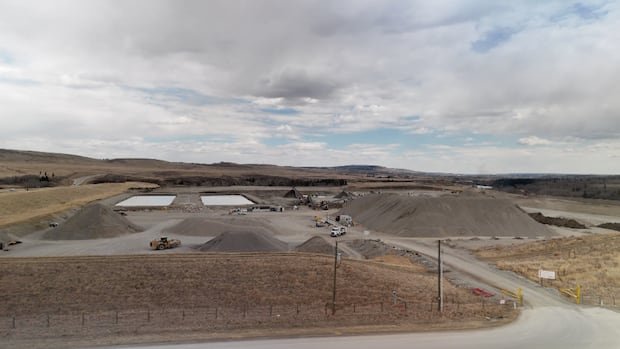

Seven local residents are contesting the provincial government’s approval of a gravel pit situated west of Cochrane, Alberta. The pit, managed by Calgary-based BURNCO Rock Products Ltd. since 2016, spans an area equivalent to about 100 football fields and is positioned uphill from the Bow River, approximately a hundred meters away at its nearest point.
In 2023, the provincial government sanctioned BURNCO’s proposal to expand the pit’s area by approximately five times its current size. BURNCO has assured that it will not extract more than a sixth of the extended site at any given time and intends to restore the land gradually to its original state as pasture and farmland.
Local residents are expressing concerns about the perceived environmental repercussions of the operation, particularly regarding potential risks to groundwater. A key issue now revolves around the water use approval granted to BURNCO for the expanded site in 2024, which is under review by the provincial Environmental Appeals Board (EAB). Although a virtual appeal hearing was initially scheduled for mid-March, it was postponed due to procedural and legal challenges raised by all parties, with no new date announced at present.
The Stoney Nakoda community is also engaged in the appeal process, highlighting potential adverse effects on their land related to groundwater, surface water, and wetlands in the area. Alongside the seven local residents contesting the gravel pit’s water use approval, the Town of Cochrane, Rocky View County, and Stoney Nakoda Nations have been granted intervenor status in the appeal hearing.
While the Town of Cochrane has not opposed BURNCO’s project, it has emphasized the need for additional clarity and assurance to comprehend and manage the potential impacts of the pit effectively. Rocky View County is also participating in the appeal, although it did not provide comments to CBC regarding its involvement.
In contrast, the City of Calgary is not directly involved in the dispute. In 2022, the city raised concerns to the province regarding the pit’s potential impact on the water quality of the Bow River. Following discussions with BURNCO in the subsequent year, Calgary determined that the risk was minimal.
The individuals challenging the provincial government argue that the current regulations fall short in adequately assessing environmental risks before permitting such projects to proceed. Ann McKendrick McNabb, one of the appellants, stresses the need for more data on potential environmental impacts on local creeks, natural springs, soil, and groundwater. She asserts that stringent policies, audits, transparency, and trust are essential when projects have a significant impact on the Bow River corridor.
Although BURNCO has conducted and submitted various studies to the province, including wetland assessments and plans for stormwater management, erosion control, and reclamation, McKendrick McNabb and other appellants are advocating for an independent, audited environmental impact assessment (EIA) to be mandated for the company.
In Alberta, EIAs are obligatory before project approval under provincial environmental protection legislation when there is uncertainty about the environmental effects or the potential for significant adverse impacts. While certain large-scale projects require mandatory EIAs, such as dams, mines, power plants, and tourist facilities, gravel pits have been exempt from this requirement since 2020 following a regulation change to Alberta’s Environmental Protection and Enhancement Act.
Despite not being mandated, the environment minister retains the discretion to order an EIA if deemed necessary. However, for the Cochrane West gravel pit, no such order has been issued. BURNCO has stated that it underwent Alberta’s established environmental permitting process, which includes a comprehensive review of environmental considerations.
The appellants contesting the water use approval emphasize the significant personal costs and efforts involved in participating in the environmental appeal process. They stress the need for a more inclusive and transparent system that shifts the burden from landowners to aggregate companies benefiting from proposed projects, ensuring proper environmental impact assessments are conducted.
Jason Unger from the Environmental Law Centre highlights the limitations of the current approval system, which can hinder public participation in addressing environmental concerns during the early stages of project applications. He advocates for a more organized zoning system and broader community discussions to streamline the process and enhance transparency.
While the environment ministry refutes claims of unfairly burdening ordinary Albertans in the approval process, stating there are ample opportunities for public input, the opposition has requested the appeal board to halt BURNCO’s water use approval until a final decision is made after the hearing. Despite the board’s decision not to pause the approval, the government has indicated that BURNCO has the option to proceed with its operations.
Alberta Environment and Protected Areas defend the current regulations for gravel pit approvals, asserting that they offer a sensible approach to regulation that safeguards the environment. The ministry refrained from commenting further on the Cochrane West gravel pit dispute, citing the ongoing appeal process.