

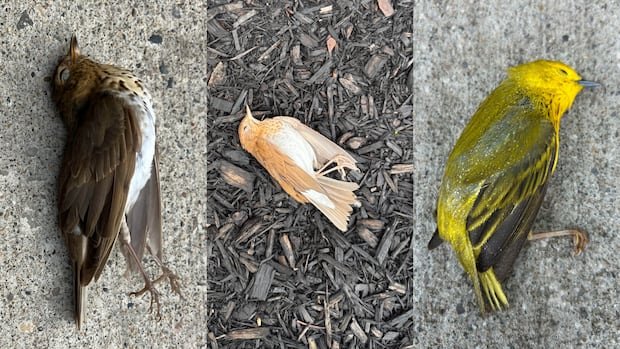

A small Swainson’s Thrush with brown feathers, a vibrant Northern Yellow Warbler, and a plump Veery were discovered lifeless on the same day in downtown Kitchener, potentially perishing within moments of each other.
Meredith Blunt, the founder of Bird Friendly Kitchener, recounted finding the thrush, noting its warmth as she held it in her hands. Since August 2025, Blunt has been monitoring bird fatalities resulting from window collisions in downtown Kitchener, where migratory birds, some having traveled thousands of kilometers, meet unfortunate ends.
Blunt has gathered a total of 234 birds, with only two out of seven found alive surviving rehabilitation efforts. She identified problematic buildings such as Google, Oracle, Hall’s Lane, the Galleria, and both old and new courthouses as major collision hotspots.
Upon identifying these locations, Blunt’s team reaches out to property managers to address the issue. However, some scheduled meetings have not been attended by the concerned parties. Perimeter, co-owner of the Google building, and Infrastructure Ontario, responsible for the courthouses, have acknowledged the concerns raised and are working towards solutions.
Inspired by FLAP Canada, a charity tracking bird-window collisions nationwide, Blunt’s initiative aims to raise awareness about the issue. FLAP’s Global Bird Collision Mapper has recorded over 3,200 bird fatalities in Canada in 2026, emphasizing the severity of the problem.
Michael Mesure, FLAP Canada’s executive director, highlighted Toronto’s specific challenges due to its topography, vegetation, and abundance of human-made structures with glass, creating a hazardous environment for birds during migration periods.
Ryan Norris, an ecologist from the University of Guelph, emphasized that bird collisions are a significant concern across Canada, especially during spring migration. He noted the increased danger posed by reflective surfaces and bright lights for birds.
Blunt recommends starting bird safety measures at home, suggesting the use of anti-collision stickers on windows, especially in single-family homes. Mesure advocates for incorporating bird safety measures into national and provincial building codes to safeguard avian populations.
While convincing commercial and office building managers to adopt bird safety measures may pose challenges, Norris suggested evolving anti-collision stickers to be more aesthetically acceptable. He proposed the need for bylaws to accommodate these evolving technologies for broader adoption.
Overall, the efforts of advocates like Blunt and organizations like FLAP Canada underscore the importance of addressing bird-window collisions to protect bird populations during their migratory journeys.