

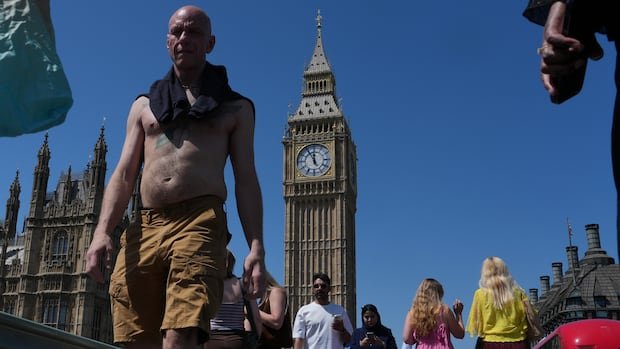

The United Kingdom broke a century-old temperature record for the second time within 24 hours during an ongoing spring heat wave across Western Europe, prompting official warnings of life-threatening risks. London’s Kew Gardens and Heathrow Airport registered a temperature of 35 degrees Celsius, surpassing the previous day’s record of 34.8 degrees Celsius at Kew. This provisional data shattered the longstanding record of 32.8 degrees Celsius established in 1922 and equaled in 1944.
London experienced a rare phenomenon known as a “tropical night,” where the temperature did not drop below 20 degrees Celsius. Meanwhile, France also witnessed record-breaking temperatures, with the southwest region reaching 36 degrees Celsius on Monday and maintaining nighttime temperatures above 20 degrees Celsius.
Several drowning incidents were reported in both Britain and France as individuals sought relief from the heat. Authorities attributed the extreme weather to a “heat dome,” a weather pattern characterized by high-pressure systems trapping heat, leading to temperatures more than 10 degrees higher than usual for this time of year.
Climate experts emphasize that the frequency of unpredictable and severe weather events is increasing due to global warming. Peter Thorne, director of the ICARUS Climate Research Centre at Maynooth University, highlighted the role of climate change in intensifying heat waves, describing the current records in the UK and France as “mind-bogglingly crazy.”
Following a weekend of heightened outdoor activities, London’s public transport system faced challenges on Tuesday, with commuters enduring sweltering conditions on unventilated subway trains. In Scotland, firefighters battled a grass fire near Edinburgh’s Arthur’s Seat throughout the night.
Health authorities in the UK issued an amber health alert for several regions, cautioning about health risks, especially for vulnerable groups during the hottest parts of the day. The country’s lack of widespread air conditioning in homes, schools, and businesses compounded the discomfort caused by the heatwave.
Tragically, multiple drowning incidents were reported in the UK and France, with teenagers and adults losing their lives in bodies of water. The French government also noted an increase in emergencies along the coast, emphasizing the need for caution among beachgoers.
The unseasonably high temperatures extended beyond the UK and France, affecting Spain and Italy as well. Spain experienced summer-like temperatures in May, with Seville reaching 38 degrees Celsius, while Rome expected temperatures to climb to 32 degrees Celsius.